
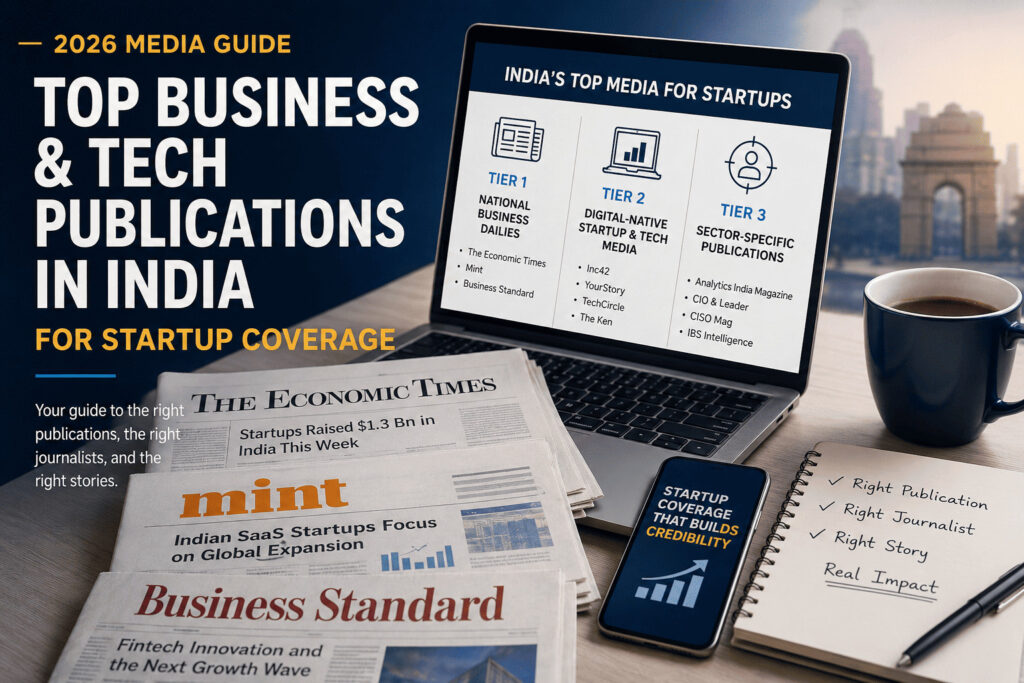
Not all Indian media coverage is equal. A startup that focuses its PR on the right 15 publications will generate more business impact than one that sends press releases to 150. The difference is understanding what each publication covers, who reads it, and what makes a story land with that specific desk.
This is a working guide to the publications that matter for Indian startups in 2026, organised by what they’re best for.
Tier 1: National business dailies (investor and enterprise credibility)
The Economic Times is India’s highest-circulation English business daily and the first destination for funding announcements, leadership appointments, and major corporate developments. The ET Tech and Startup sections are the most relevant for technology companies. Coverage here signals seriousness to investors and enterprise buyers. Pitching requires strong news value — ET journalists receive hundreds of press releases daily and respond primarily to direct relationship outreach. Turnaround on a query is typically 24 to 48 hours.
Mint has a more analytically rigorous editorial standard and a reader base with a higher average household income and seniority than ET. The Mint Tech and Mint Money sections cover technology and fintech respectively with more depth and less volume than ET. Mint is the right target for a story that has a strong data angle or a contrarian market thesis.
Business Standard is the preferred reading of CFOs, board members, and policy professionals. For startups, it’s most valuable for BFSI-adjacent stories, regulatory commentary, and leadership profiles. The BS Tech section covers startup news, but the paper’s real strength is its business and policy readership.
Tier 2: Digital-native startup and technology media (ecosystem positioning)
Inc42 is the publication that India’s startup ecosystem reads. Investors, founders, ecosystem professionals, and talent check Inc42 for funding news, founder interviews, and sector analysis. For a funding announcement, Inc42 is often the highest-value placement alongside or slightly below the national dailies.
YourStory reaches a broader startup ecosystem audience, with particular strength in founder profiles, regional startup coverage, and the impact and social enterprise space. If your company has a founder journey story or regional roots, YourStory’s audience responds to it.
TechCircle is the publication enterprise technology buyers and CIOs read. For B2B SaaS, cloud, AI, and enterprise technology companies, TechCircle is often the most relevant publication for reaching actual procurement decision-makers.
The Ken produces longer-form, deeply researched pieces on Indian technology and business. A Ken feature takes longer to land than a standard press piece, requires more reporter access and data, and produces journalism that stays authoritative for months. For a company with a genuine, complex story to tell, a Ken piece is worth significant investment.
Tier 3: Sector-specific publications (technical credibility)
Analytics India Magazine covers AI, machine learning, and data science with a technical readership. For AI companies, a feature or op-ed here reaches the engineers and data scientists who evaluate technology, not just the executives who buy it.
CIO & Leader reaches the IT decision-makers in Indian enterprises — the audience that approves technology purchases. For SaaS and enterprise software companies, this is a high-value target that receives relatively fewer startup pitches than the national dailies.
CISO Mag covers cybersecurity with a practitioner readership. For security-adjacent startups, this is a credibility channel that generic business media cannot provide.
IBS Intelligence covers banking and financial technology internationally but with strong India readership among BFSI technology decision-makers. For fintech and BFSI-adjacent companies, a placement here reaches an audience that most startup PR entirely misses.
How to approach each tier
For tier 1 dailies: relationship is everything. Direct email to a named journalist you have a prior connection with, or an introduction through a PR agency with that relationship, significantly outperforms sending to a generic editor inbox. Lead with the news value in the subject line. Attach the press release; don’t paste it in the email body.
For tier 2 digital native: email and LinkedIn DM both work. These publications are more accessible than the national dailies, respond faster, and are more willing to cover stories at earlier stages. Personalise the pitch — explain why the story fits their specific readership.
For tier 3 specialist: the pitch needs to demonstrate technical credibility. A story that would work for ET (“startup raises ₹50 crore”) needs a different angle for Analytics India Magazine (“here is how our architecture handles real-time inference at scale”). Write the pitch for the readership, not for a generic journalist.
Frequently Asked Questions
Should startups target international publications like TechCrunch?
For companies with a credible international story — significant foreign investment, a product built for global markets, or a global customer base — yes. For companies at an early stage building primarily for India, the domestic media focus is more valuable. TechCrunch India interest typically follows Inc42 and ET coverage, not precedes it.
How do you get a journalist to cover your startup if you have no existing relationships?
Comment thoughtfully on their published work before pitching. Introduce yourself at events. When you do pitch, do it in one or two sentences that are specific to their beat. Don’t send a 500-word pitch email to a journalist who doesn’t know your name.
Is print or digital coverage more valuable in 2026?
Digital for discoverability — online articles appear in search results and AI search answers, print articles typically don’t. Print for board and investor signalling — a physical newspaper is still the format that carries the most prestige in boardrooms. For most startups, digital-first publications produce more business impact.
