
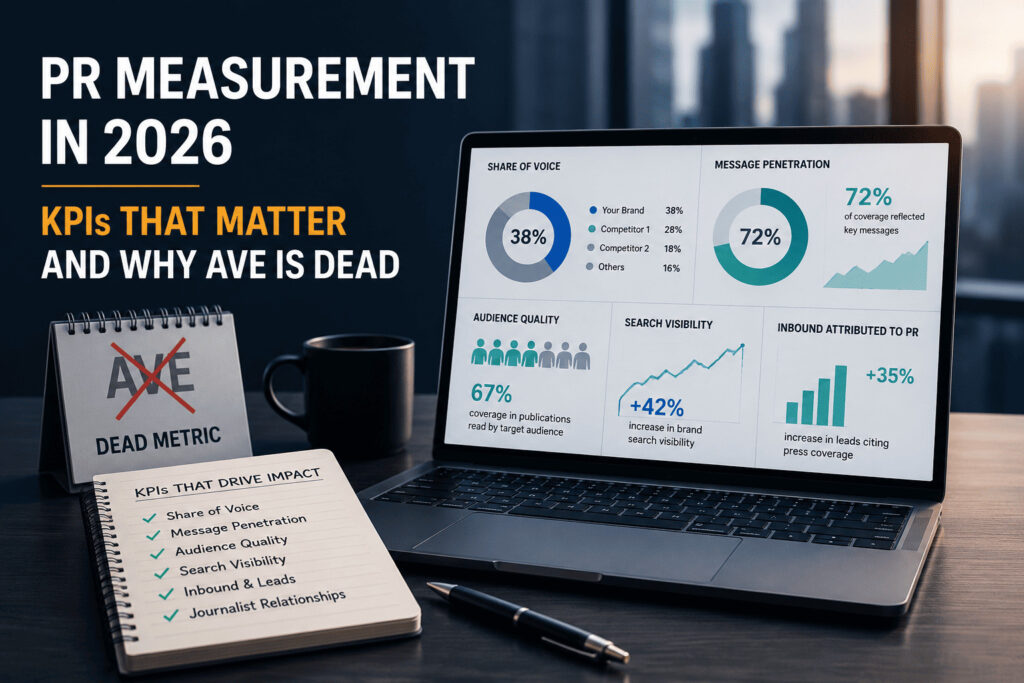
The most common PR measurement practice in India in 2026 is still the coverage report: a monthly PDF with clippings, publication names, reach figures, and an Advertising Value Equivalent. Most clients have been receiving these reports for years. Most of them don’t know what to do with the numbers.
This is a measurement problem, and it’s costing companies real money. When PR can’t demonstrate its contribution to business outcomes, it gets treated as a discretionary expense — the first line to cut when budgets tighten. When it can, it gets treated as an investment.
Why AVE is the wrong metric
AVE — Advertising Value Equivalent — calculates the hypothetical cost of buying the equivalent space as an advertisement. An article in Mint earns a higher AVE than an article in a regional daily. A front-page mention earns more than a paragraph inside the paper.
The problem is that AVE measures the wrong thing. It values coverage by the cost of the space, not by whether anyone read it, whether they believed it, whether they acted on it, or whether it changed how they perceive your brand. A ₹25 lakh AVE generated by 40 coverage pieces in publications your target audience doesn’t read is worth less than one ₹2 lakh AVE piece in the publication your enterprise buyers read every morning.
The Barcelona Principles — the global PR industry’s framework for measurement, first adopted in 2010 and updated since — explicitly reject AVE as a valid metric. Most serious agencies have moved on. The industry standard in 2026 is outcomes measurement: what changed because of the communication?
The metrics that actually connect to business
Share of voice. What percentage of the total coverage in your sector, across a defined set of publications, mentions your brand versus competitors? This is a relative measure — it tells you whether your communications investment is keeping pace with, falling behind, or pulling ahead of the market.
Message penetration. Of the coverage you received in a period, what percentage correctly reflects your key messages? This requires reading and coding the coverage, not just counting it — but it’s the only way to know whether your narrative is actually landing with journalists and, through them, with readers.
Audience quality. Not total reach, but the percentage of coverage appearing in publications your actual target audience reads. For a B2B SaaS company, 500,000 reach in general lifestyle media is less valuable than 50,000 reach in CIO & Leader and TechCircle.
Search visibility. Is media coverage contributing to your brand’s appearance in Google search results and AI search answers for relevant queries? This is trackable through Google Search Console, rank tracking tools, and monthly manual checks on AI search platforms.
Inbound attributed to PR. How many leads, meeting requests, or partnership inquiries cite press coverage as the reason they reached out? Ask on every inquiry form and in every first meeting. The data is imperfect but more honest than AVE.
Journalist relationships. Are journalists contacting you proactively for comment, rather than requiring constant outreach? This is a qualitative metric but a meaningful one — it signals that your brand is recognised as a credible source in the sector, which is the underlying goal of media relations.
How to set up a measurement framework
The framework should be set before the agency engagement begins, not after three months of coverage reports arrive. It requires three inputs: the business objective (what does the company need to achieve in the next 12 months), the communications objective (what role does PR play in that), and the measurement approach (how will we know if PR contributed).
A realistic framework for a growth-stage Indian company might look like: business objective — close five enterprise accounts in the next 12 months; communications objective — be visible to procurement decision-makers in the BFSI and logistics sectors; measurement — share of voice in TechCircle and IBS Intelligence monthly, number of inbound meeting requests citing press coverage quarterly, and AI-search visibility for the top five buyer queries monthly.
This framework is simple, specific, and directly connected to the business goal. Coverage count and AVE don’t appear in it.
Quarterly reporting that works
The measurement report that’s actually useful contains four things: what the coverage achieved against the framework metrics (not just a list of clippings), what didn’t work and why, what the plan is for the next quarter, and what the business is being asked to provide (approvals, time for journalist briefings, customer permission for case studies) to make the plan work.
A report that only tells the client what happened is a history. A report that also tells them what to do next is a management tool.
Frequently Asked Questions
Should PR be held to revenue attribution?
Revenue attribution for PR is directionally possible but practically difficult, because the path from a press mention to a closed deal involves too many intermediate steps. Hold PR accountable for the metrics it can directly influence — share of voice, message penetration, inbound quality — and connect those to revenue through a logical chain rather than direct attribution.
How often should PR be measured?
Monthly for activity metrics (coverage achieved, share of voice). Quarterly for outcome metrics (message penetration, inbound quality). Annually for the strategic review of whether the communications approach needs to change.
What’s the minimum viable measurement setup for a company with no PR infrastructure?
Google Search Console (free, tracks search visibility), a media monitoring tool (Meltwater, Mention, or Agility PR Solutions at varying price points), and a simple CRM field asking leads how they heard about the company. These three, used consistently, give you more useful data than a monthly AVE report.
