
Most Indian companies don’t have a crisis communication plan until they need one. By then, the window for controlling the narrative has usually closed.
A crisis in communications terms is any event that creates sudden, significant pressure on an organisation’s reputation with a material audience — customers, investors, employees, regulators, or the press. Product failures, data breaches, leadership misconduct allegations, regulatory actions, employee incidents: each has a different content, but the communications logic is the same. Speed, accuracy, and consistency in the first 24 hours determine how much damage is contained.
The non-negotiable preparation steps (do these before a crisis)
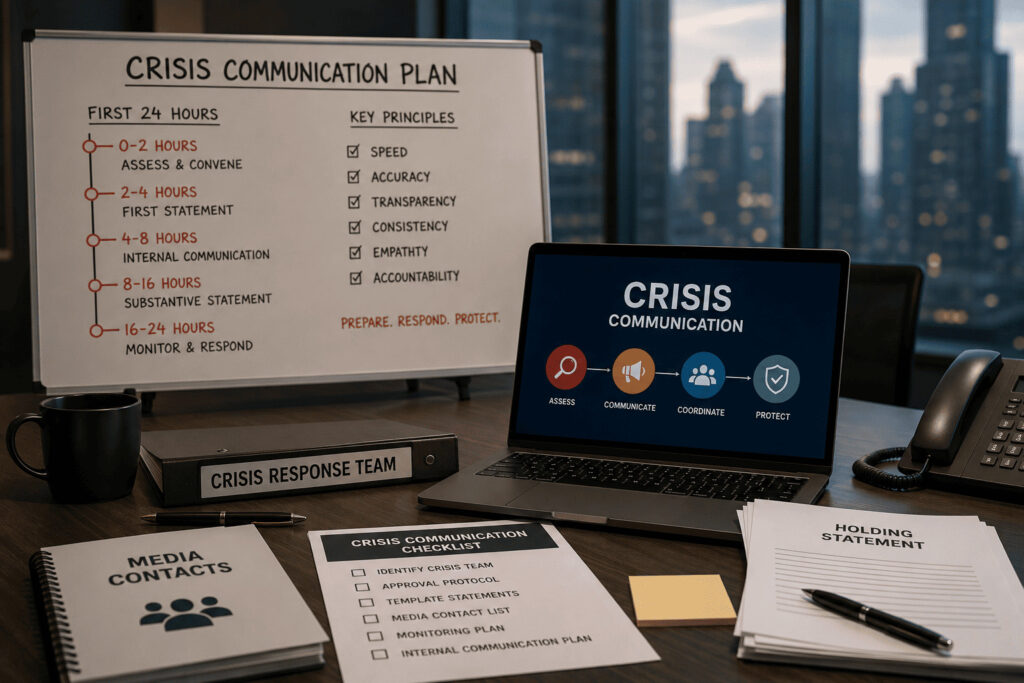
Identify your crisis team. Crisis communications requires four roles to be pre-assigned: the decision-maker with authority to approve statements (typically the CEO or MD), the spokesperson who speaks to media (not always the same person), the legal reviewer who checks statements before release, and the communications lead who coordinates everything. If you haven’t named these people before a crisis hits, you will spend the first four hours finding them.
Build a media contact list. Not a press release distribution list — a list of the ten to fifteen journalists who are most likely to cover a crisis in your sector, with verified current contact details. A list built in a crisis, from memory, will be incomplete and will have outdated contacts.
Prepare template statements. Three templates covering the most plausible crisis types for your business: one for product or service failure, one for data or security incident, one for leadership or personnel matters. Templates don’t replace situation-specific statements, but they give the communications lead a starting framework at 11 PM on a Sunday.
Define the approval protocol. Who needs to sign off on a statement before it goes out? What is the maximum time that approval process is allowed to take? Anything over two hours is too slow for a fast-moving media situation.
The first-24-hours protocol
Hour 0–2: Assess and convene. Confirm what happened, what is known, and what is uncertain. Convene the crisis team. Do not issue a public statement until you know at minimum: what the facts are, who is affected, and whether the situation is contained or still developing.
Hour 2–4: First statement. Issue a holding statement — a short, factual acknowledgement that you are aware of the situation and are investigating. This does three things: it prevents the narrative from being filled entirely by other voices, it signals to affected stakeholders that the company is responsive, and it buys time for a fuller statement. A holding statement is not an apology and is not an admission of fault. It is simply: we know, we’re looking into it, we’ll update you.
Hour 4–8: Internal communication. Employees should hear what the company knows before they read it in the press. A brief internal message from the CEO or MD, aligned with the external holding statement, prevents the speculation and misinformation that spread in internal WhatsApp groups during media silence.
Hour 8–16: Substantive statement. Based on what is now confirmed, issue a fuller statement. This should include: what happened (factual, specific), what action is being taken, and what affected parties can do. If there is genuine accountability, acknowledge it. Statements that are evasive on obvious facts extend the media cycle — journalists will keep asking the questions the statement doesn’t answer.
Hour 16–24: Monitor and respond. Track coverage as it emerges. Respond to direct media queries. Correct specific factual errors through the journalist directly, not through a public counter-statement. Prepare for the next wave of questions, which typically comes when early coverage is picked up by larger publications.
What not to do
Do not go silent. Silence is interpreted as either guilt or incompetence. In the absence of a company statement, media will fill the gap with sources who may have incomplete or inaccurate information.
Do not issue a statement that raises more questions than it answers.“We take all matters seriously and are committed to the highest standards” tells the affected audience nothing. Every word of a crisis statement should be tested against: does this answer the question a reasonable person is asking?
Do not let legal review become a veto on communication. Legal’s job is to ensure statements don’t create additional liability. It is not legal’s job to prevent communication. The two functions need to work in parallel, not sequentially.
Do not brief different journalists differently. Inconsistent information across media contacts produces contradictory stories, which extends the crisis and adds a “company confused about its own situation” narrative on top of the original problem.
Frequently Asked Questions
Should the CEO always be the spokesperson in a crisis?
Not necessarily. The CEO is the right spokesperson for situations affecting the whole organisation or its fundamental integrity. For operational or product-specific crises, a head of operations or technical lead may be more credible. The spokesperson should be the person with the most relevant authority and the most prepared to answer the specific questions the crisis raises.
When does a crisis require a PR agency rather than an in-house response?
When the media interest is significant enough that managing incoming press queries becomes a full-time job, when the situation requires 24-hour monitoring, or when the reputational stakes are high enough that senior external counsel adds more than in-house management can. Most major crises benefit from external crisis communications support.
How long does a media crisis typically last?
A well-managed crisis with clear, honest communication typically generates two to four days of active coverage and two to three weeks of residual mentions. A poorly managed one — evasive statements, contradictory messages, delayed responses — can run for months and resurface at every related news event.
