
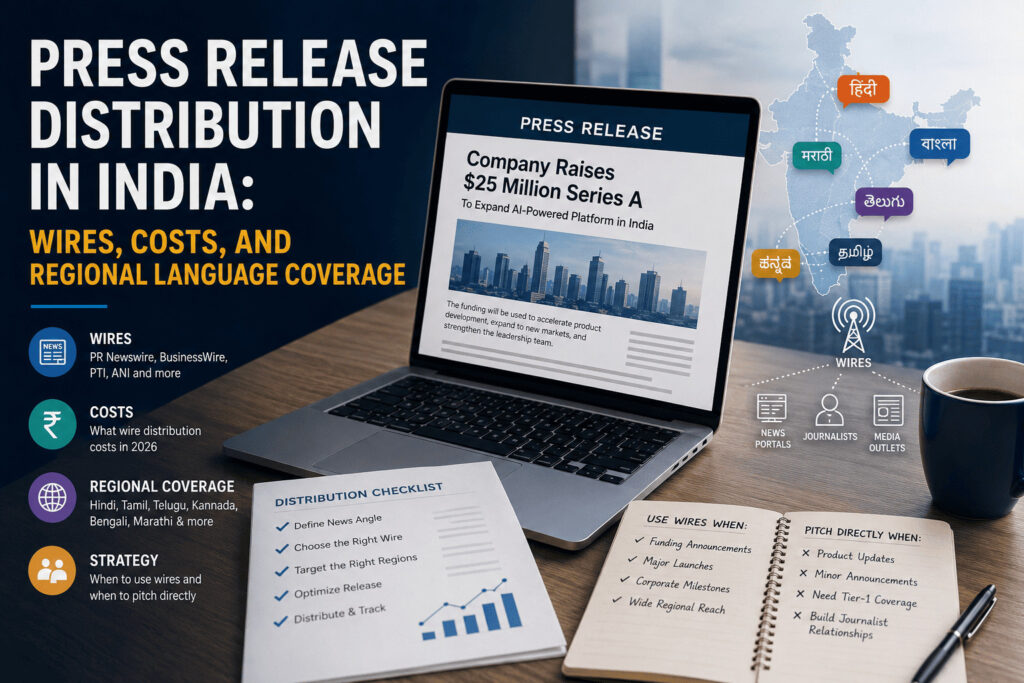
Press release distribution is the most misunderstood and most overused tactic in Indian startup PR. Companies spend money on wire services expecting coverage; they get syndication. These are different things, and the difference matters.
This post covers how press release distribution actually works in India in 2026, what the wire services cost, when regional language coverage is worth pursuing, and — most importantly — when to skip the wire entirely and go direct.
How wire distribution works in India
A wire service takes your press release and distributes it to a media list — editorial desks, journalists, and online syndication partners — simultaneously. In India, the two primary wire services used for commercial PR distribution are PR Newswire (part of Cision) and BusinessWire India. PTI (Press Trust of India) and ANI (Asian News International) are news agencies that also distribute releases for commercial clients.
When a wire release goes out, it typically:
- Appears on the wire service’s own portal, which is indexed by Google
- Is syndicated to partner news aggregators and online portals (Zee News digital, Daily Hunt, and similar platforms)
- Lands in the inboxes of editorial desks that subscribe to that wire
What it does not typically do: compel a journalist to write a story about it. Journalists at Economic Times, Mint, and TechCircle receive dozens of wire releases daily. The release itself is a signal that a company has news; the journalist relationship and the quality of the pitch are what produce actual coverage.
Wire service costs in India (2026 estimates)
PR Newswire India: national distribution releases typically run ₹35,000 to ₹80,000 per release, depending on word count and distribution list. International distribution options are available at higher rates. Regional language add-ons are priced separately.
BusinessWire India: broadly comparable pricing to PR Newswire, ₹30,000 to ₹70,000 for a national release.
PTI commercial distribution: PTI’s commercial service distributes to PTI-subscribed editorial clients, which includes most major Indian English and Hindi-language publications. Pricing varies by word count and is typically ₹20,000 to ₹50,000 per release.
ANI: broader in regional language reach, comparable pricing.
These costs cover distribution, not coverage. A company that sends 12 wire releases a year without direct journalist outreach is spending ₹4 to ₹9 lakh annually on syndication, not PR.
When wire distribution is worth it
Funding announcements. Wire distribution for a funding round ensures the announcement reaches regional editors and smaller publications without individual pitching effort. It also creates a timestamped, indexed record of the announcement that appears in Google results.
Major corporate milestones. A new GCC centre launch, a significant partnership, a listed-company material event. These benefit from broad simultaneous distribution.
Reaching long-tail regional and trade media. Direct pitching at scale across 50 regional publications is operationally impractical. Wire distribution covers the long tail.
When wire distribution is not worth it
Product feature updates. No journalist writing for Mint or Inc42 will cover a product feature update from a wire release. Direct pitch a specific angle to a specific journalist, or put it on the company blog.
“Strategic partnership” announcements that are really vendor contracts. Two companies announcing they’ve partnered without any specifics of what the partnership produces is not news. Wire distribution of a non-story produces no coverage and trains journalists to ignore future releases.
Anything where you need tier-1 coverage. The path to ET or Mint runs through a journalist relationship and a direct pitch, not a wire. Wire distribution and tier-1 coverage are parallel activities, not the same thing.
Regional language distribution: when it matters
For consumer-facing companies with significant markets in non-English speaking India, regional language press release distribution is worth considering. Hindi, Tamil, Telugu, Kannada, Bengali, and Marathi are the markets with the largest regional business media presence.
PTI carries Hindi-language releases and has the deepest regional newsroom penetration of any Indian wire. ANI has strong reach in broadcast-adjacent regional media.
The practical test: does your company’s news have relevance to audiences in regional language markets? A B2B SaaS company raising a Series A probably doesn’t need Telugu-language distribution. A consumer fintech expanding to tier-2 cities in Andhra Pradesh probably does.
Frequently Asked Questions
Does a wire-distributed release improve SEO?
Modestly. Wire portals are indexed and releases appear in Google results. The SEO value of a press release on PR Newswire’s portal is limited compared to a genuine publication placement, but it contributes to the Google trail for your brand name.
Should startups distribute every press release on wire?
No. Reserve wire distribution for genuinely significant news — funding, major launches, leadership appointments. Sending minor updates on wire devalues the signal when something significant actually happens.
Can a startup get PTI to run a story without paying for their commercial distribution service?
Yes, if the news has genuine editorial value and a journalist at PTI covers the beat. PTI’s editorial and commercial operations are separate. A funded story in PTI’s editorial wire carries significantly more credibility than a commercial PTI distribution.
