
How long before we start seeing results?” is the question every client asks in the first meeting, and it deserves a direct answer rather than the vague “it depends” most agencies offer.
The honest answer has several parts: some things show up quickly, some things take longer than clients expect, and the definition of “results” matters enormously.
What "results" actually means
Before the timeline, the definition. PR produces different kinds of results on different schedules:
Coverage — press mentions — comes first and is the most visible metric.
Relationship — journalists who recognise your name and respond to pitches — takes longer.
Reputation — the brand being associated with a category, consulted by media, and mentioned in relevant conversations — takes longest and is the most valuable.
Most clients are measuring for coverage. They should be building toward reputation. The timeline for each is different.
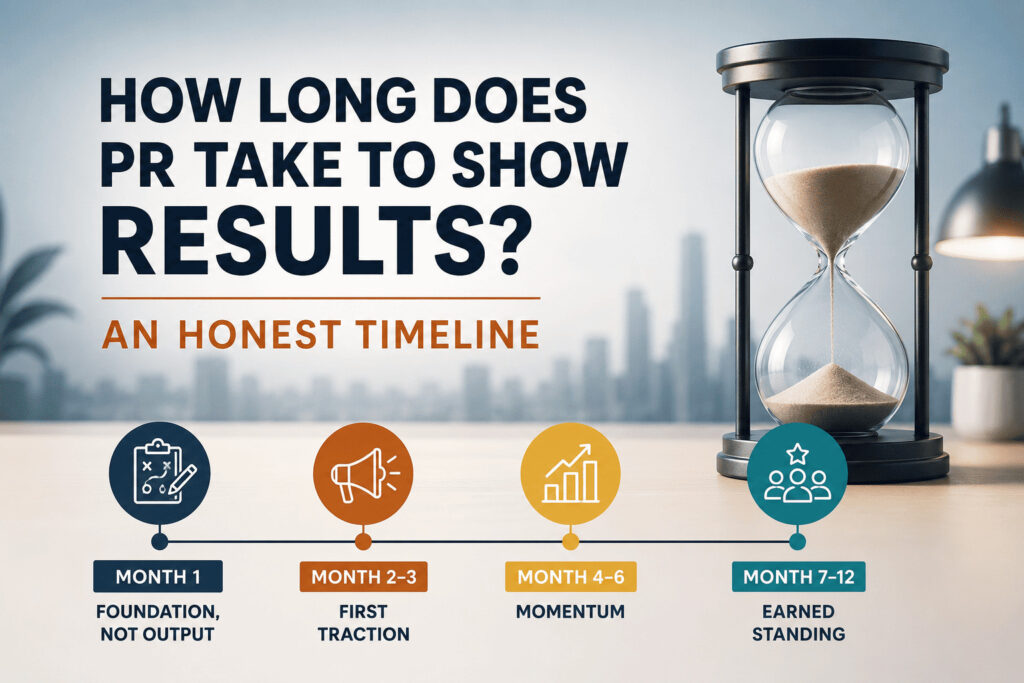
Month 1: Foundation, not output
In a well-run engagement, Month 1 is mostly invisible from the outside. The agency is: learning the business and the sector deeply enough to brief journalists accurately; mapping the media landscape and identifying the 15 to 25 journalists worth building relationships with; developing the narrative and messaging that will drive all pitching; and identifying the first news hooks — stories available to pitch now.
Coverage in Month 1 is possible, particularly if there’s a live news peg (a funding round, a launch, a leadership appointment). Without a hard news hook, Month 1 coverage is rare from a cold start, and any agency that guarantees it in Month 1 is making a promise that requires cutting corners on the foundational work.
Month 2–3: First traction
This is when the first wave of coverage typically appears. The agency has made initial journalist outreach, has begun building relationships at the desks most relevant to your sector, and has a sense of which angles are landing.
Realistic expectations for months 2–3: two to five pieces of coverage in relevant publications, the first journalist responding to a follow-up pitch, and the first sense of which story angles are working.
What Month 2–3 is not: tier-1 coverage in Economic Times or Mint from a cold start. Those relationships take longer. A company that gets ET coverage in Month 2 either had pre-existing agency relationships with that desk, a genuinely exceptional news hook, or got lucky. All three happen — none should be expected as standard.
Month 4–6: Momentum
By Month 4, a competent agency has established working relationships with the key journalists in your sector. Pitches are getting responses rather than silence. Some journalists have come back for a second story. Coverage is appearing with reasonable consistency.
This is also when the compound effect of consistent communications begins to show: the Google trail for your company and your founders is building, journalists are beginning to recognise the name, and the occasional inbound query from a publication that heard about you through another journalist starts to appear.
Month 4–6 is when clients start to feel the engagement is working. It’s also when agencies get complacent if they’re not managed well — the urgency of Month 1 can fade into routine. The monthly reporting meeting matters more now, not less.
Month 7–12: Earned standing
By Month 9 to 12 of a consistent engagement, something shifts. The brand is no longer pitching from a cold start — journalists have existing context. Some are reaching out proactively for comment on sector stories they’re writing. The company is appearing in coverage as a named source, not just as the subject of its own press releases.
This is what “PR results” actually look like at full velocity. It cannot be manufactured in Month 2. It is built through 8 to 10 months of consistent, credible outreach and genuine relationship development.
The factors that accelerate or slow the timeline
Accelerators: a strong news hook in the first 30 days (funding announcement, major launch, industry recognition); a founder who is genuinely accessible and willing to do journalist briefings; a PR agency with existing relationships in your specific sector; approved customer case studies available to share.
Decelerators: approval processes that take more than 48 hours; a founder or spokesperson who cancels journalist briefings; a sector that is genuinely unfamiliar to the agency; unrealistic expectations that produce early disappointment and disengagement before the programme has time to build.
The question behind the question
When clients ask “how long before we see results?”, they’re usually asking something more specific: “how do I justify this spend to my board before the next quarterly review?” That’s a legitimate question, and the answer is to agree on Month 3 and Month 6 metrics at the start of the engagement — share of voice in target publications, number of media relationships established, specific coverage quality benchmarks — rather than waiting for the question to come up under pressure.
PR that can demonstrate its progress at every stage is PR that survives budget conversations.
Frequently Asked Questions
What’s the minimum engagement period to give PR a fair chance?
Six months is the professional consensus. Three months can show early traction but is rarely enough to build the journalist relationships that produce consistent results. Twelve months is where the full compound value of consistent communications becomes visible.
Is PR faster for a company that already has media coverage?
Yes, meaningfully so. A company with an existing media trail is not starting cold — journalists can check prior coverage, the narrative is partially established, and the agency is building on existing relationships rather than creating them from scratch.
What happens to the results if we pause and restart PR?
Relationships with journalists decay if not maintained — a six-month pause typically requires rebuilding a significant portion of the relationship capital that took months to establish. The Google trail and existing coverage persist, but the active momentum does not.
