
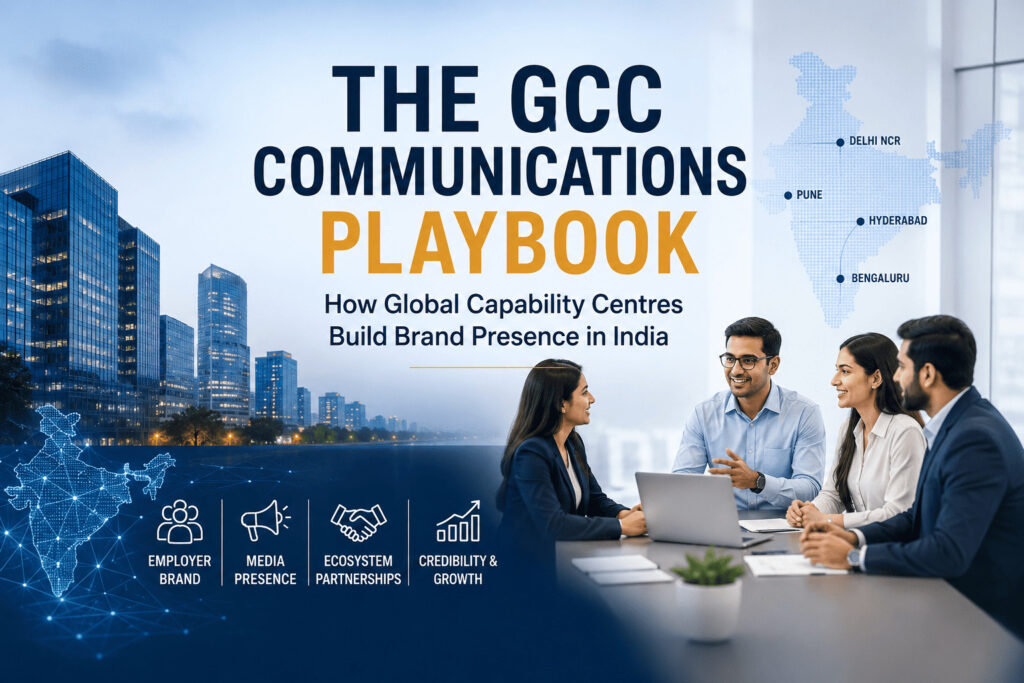
India now hosts over 1,700 Global Capability Centres, and over 100 new centres are announced annually. Every one of them faces the same communications challenge in the first 18 months: they are unknown in the local market, competing for talent against companies with established brand equity, and expected by their global headquarters to establish credibility quickly.
The problem isn’t that GCCs lack substance. They typically have strong parent brands, real work, and competitive compensation. The problem is that local Indian audiences — talent, media, and institutional partners — have no context for the India operation specifically. Communications has to build that context from scratch.
The three audiences that matter
Talent. This is the most urgent priority for most new GCCs. A centre with 500 open positions and no brand presence in Hyderabad or Bangalore is competing against TCS, Infosys, Amazon, and every funded startup for the same candidates. Employer brand is not a marketing afterthought — it is the operational constraint that determines how fast the centre can scale.
Media and ecosystem. Local business press, technology publications, HYSEA, nasscom, and the broader GCC and startup ecosystem shape how a centre is perceived by potential partners, policymakers, and the wider talent pool. A centre that appears in TechCircle and Economic Times Bengaluru within its first six months is building a presence that passive candidates also see.
Global headquarters. The India site lead needs to demonstrate traction to HQ — not just hiring numbers, but evidence that the India operation is establishing itself credibly in a competitive market. Local media coverage, industry body participation, and speaking appearances all contribute to that internal story.
The first-90-days communications priority
The single highest-value communications action for a new GCC in India is a well-executed centre launch announcement. Not a press release — a launch programme.
A launch programme typically includes: an announcement in one or two business publications with a quote from both the global leadership and the India site head; a LinkedIn announcement from the India leader with specific details about the work being built in India (not just headcount targets); participation in one local ecosystem event in the first quarter; and the beginning of an employer brand content series on LinkedIn.
The announcement should be timed to coincide with a concrete milestone: office opening, first 50 hires, or a product delivery milestone. “We are setting up a GCC in Hyderabad” is weaker than “We have opened our Hyderabad centre and are scaling to 500 engineers by 2027.” Specificity signals seriousness.
Employer brand: what works and what doesn't
What works: employee stories with specific details about the work (“our AI team in Bangalore is building the inference infrastructure that serves 40 million daily users globally”), India leadership profiles with genuine credibility signals, and evidence of career growth paths for India-based employees.
What doesn’t work: generic “great place to work” claims without supporting specifics, stock imagery of diverse employees in open offices, and announcements about headcount without any context about what the work involves.
The talent that GCCs most want to hire — senior engineers, architects, and product managers — are experienced enough to read through employer brand marketing. They respond to specifics: what is the technical charter of the India team, who does the India site head report to and how much authority do they have, and has anyone been promoted from the India centre to a global role.
The India site head as a visible leader
The most underused communications asset for most GCCs is the India site head. A senior leader who is genuinely visible — active on LinkedIn, speaking at HYSEA and nasscom events, quoted in local business press — does more for talent acquisition and ecosystem positioning than any campaign budget.
This requires a specific programme: LinkedIn content strategy built around the leader’s genuine expertise, speaking slot applications to relevant events three to four months in advance, and deliberate media introductions to the journalists who cover technology and enterprise in their city.
The global PR agency that handles the parent brand’s communications is almost never equipped to do this. They don’t have the local journalist relationships, the ecosystem knowledge, or the understanding of what matters to Indian enterprise media. This is where a local partner with GCC experience makes a structural difference.
12-month communications roadmap for a new GCC
Months 1–3: Centre launch announcement, India leader LinkedIn activation, first ecosystem event participation.
Months 4–6: First employee story published, India leader quoted in one sector story, application to HYSEA or nasscom membership or speaking programme.
Months 7–9: First case study or technical blog published by the India team, employer brand content series begins, second local media placement.
Months 10–12: First award entry (Great Place to Work, HYSEA awards), India leader speaking slot delivered, first anniversary milestone with updated coverage.
Frequently Asked Question
Should the GCC’s India communications be handled by the global PR agency?
Global agencies typically lack local journalist relationships and ecosystem knowledge. A local Indian agency — ideally one with GCC experience — should handle India communications, either independently or in coordination with the global agency.
How much should a GCC budget for communications in India?
A first-year communications programme for a new GCC typically runs ₹18 to ₹36 lakh, including a PR retainer, employer brand content, and event participation. This is a fraction of the cost of unfilled positions caused by low brand awareness.
How long before a GCC sees meaningful talent brand improvement?
Six to nine months of consistent communications activity typically produces measurable improvement in candidate quality and application volume, based on what hiring managers report after implementing a structured programme.
