
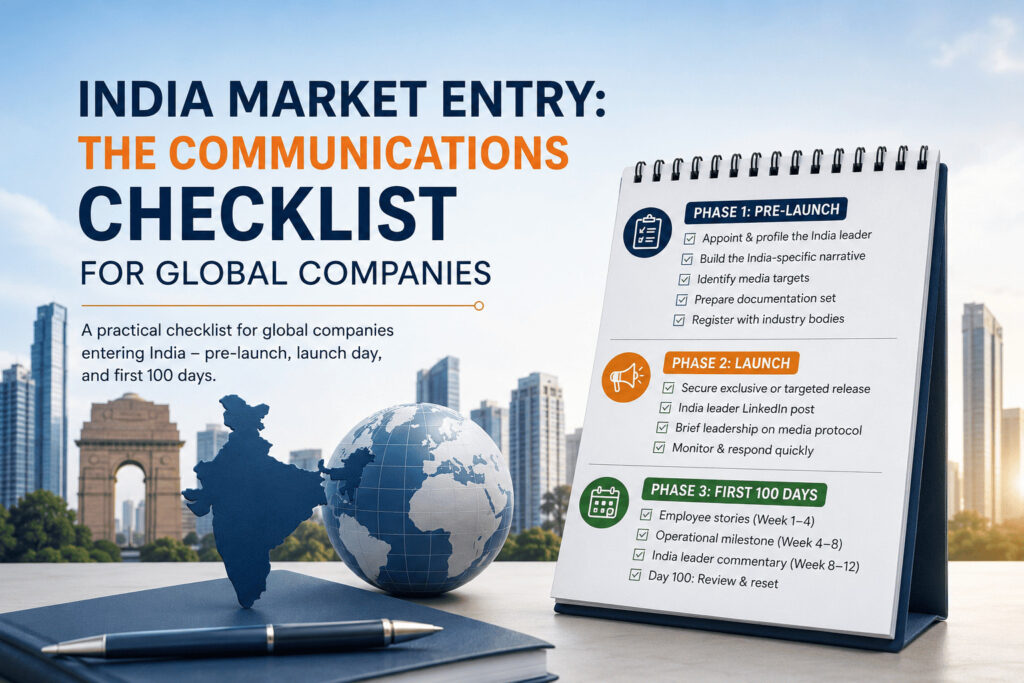
India market entry is not a single event. It is a sequence of decisions, each with a communications dimension, spread across six to twelve months. Companies that treat it as a launch moment tend to generate a spike of coverage that fades before it builds any lasting presence. Companies that treat it as a programme build the kind of market credibility that compounds.
This checklist is structured around three phases: pre-launch, launch, and the first 100 days. Each phase has specific communications actions and common failure modes.
Phase 1: Pre-launch (90 to 120 days before go-live)
Appoint and profile the India leader. The India country head or site leader is the face of the business in India. Before the launch announcement, that person should have a complete, current LinkedIn profile with a clear articulation of their role, a photograph, and at least two to three posts establishing their voice on relevant sector topics. Journalists and potential partners will check this the day they hear about the launch.
Build the India-specific narrative. The global brand story does not automatically translate to India. What problem does this company solve that is specific to India’s market? Who are the Indian customers, partners, or hires that validate the entry? The narrative should be distinct from the global one while remaining consistent with the parent brand.
Identify the media targets. Map which publications cover your sector in India, which journalists write about companies like yours, and which of those journalists have an editorial track record of covering market entries. Build a short, prioritised media list of 15 to 25 names — not a mass distribution list.
Prepare the documentation set. Press release (500 to 700 words), India leader profile, company fact sheet with India-specific data, high-resolution photos, and a Q&A document of the ten most likely journalist questions with approved answers. Get these through legal review before the launch window opens, not during it.
Register with HYSEA, nasscom, or relevant industry bodies. The ecosystem matters as much as the media in India. Registration and membership signal that the company is serious about the market, not just testing it.
Phase 2: Launch day and launch week
Choose an exclusive or a broad release — not both. For a significant entry (a GCC, a major product launch, or a large investment commitment), give one publication an exclusive with 24 to 48 hours of advance access. This produces a deeper, more credible story than a simultaneous blast to 50 journalists produces. For smaller announcements, a well-targeted direct release to 15 to 25 journalists is sufficient.
Publish the India leader’s LinkedIn post at the same time as the press release goes live. Tagging the parent company, mentioning the city, and including one specific detail about what the India team will build gives the post substance. A post that says only “excited to announce our India launch” is wasted reach.
Brief the leadership team on media protocol. Who is authorised to speak to journalists? What are the approved messages? What topics are off-limits during the launch window? This briefing takes one hour and prevents the off-the-record comment that generates the wrong story.
Monitor and respond quickly. Assign one person to monitor press queries, social mentions, and email responses on launch day. A journalist who queries at 10 AM and doesn’t hear back by noon will write without you.
Phase 3: First 100 days
Week 1 to 4: First employee stories. Real people, specific roles, why they chose to join. Consumer-facing companies benefit from video; B2B and enterprise companies benefit from LinkedIn articles and trade media placements. The first employee stories signal what kind of company this is in India.
Week 4 to 8: First operational milestone. First customer onboarded, first partnership signed, first product shipped from the India team. These milestones are news in a way that generic “settling in” content is not. Time a media outreach to coincide with each real milestone.
Week 8 to 12: India leader’s first sector commentary. A contributed article or op-ed in a relevant publication — CIO & Leader, Mint, Economic Times Tech — on a topic where the India leader has genuine expertise. This is the piece that establishes them as a voice in the Indian market, not just a visitor.
Day 100: Review and reset. What coverage was achieved? What didn’t land and why? Which publications responded and which didn’t? What does the media landscape reveal about the next six months of story opportunities? This review shapes the ongoing communications strategy.
Frequently Asked Question
How far in advance should communications planning begin for India market entry?
Six months is the minimum for a meaningful programme. Ninety days is survivable if all documentation is prepared in parallel. Thirty days — the most common scenario — produces reactive, underprepared launch communications.
Should the India communications agency be briefed before the launch is public?
Yes. An agency briefed under NDA three to four months in advance can build strategy, prepare documentation, and establish journalist relationships before the announcement window opens. An agency briefed one week before launch is executing, not advising.
Is PR for India market entry different across cities?
Yes. Mumbai is stronger for financial services, entertainment, and consumer brands. Bangalore and Hyderabad are stronger for technology, GCCs, and engineering talent. A national launch needs different media targets and different narrative emphases for each city.
