
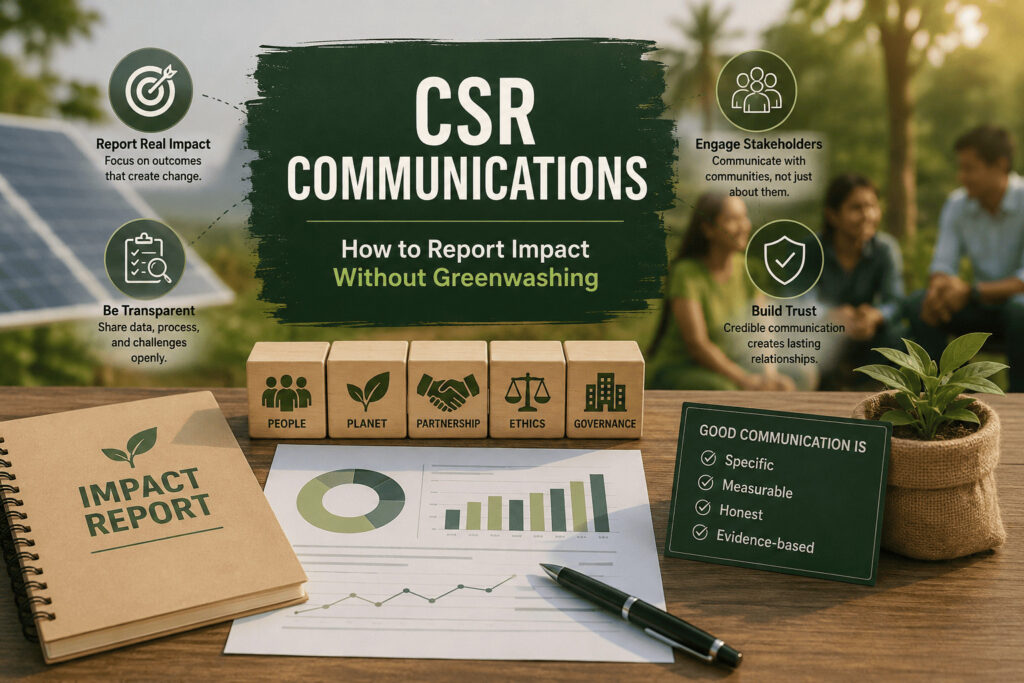
India’s Companies Act mandates CSR spending for qualifying companies, and most large Indian corporations now have formal CSR programmes. A smaller number communicate those programmes effectively. A smaller number still communicate them in a way that builds genuine stakeholder trust.
The gap between what companies spend on CSR and what they earn in reputation from it is largely a communications problem — specifically, the problem of saying things that sound impressive without saying things that are actually believed.
The credibility problem with CSR communications
Two patterns have eroded public trust in corporate CSR communication. The first is impact inflation: claims that are technically true but presented without context. “We reached 10,000 beneficiaries” tells a reader nothing about what reaching them meant or changed. The second is purpose-washing: companies claiming alignment with sustainability or social impact goals while their core operations contradict those claims.
Both patterns produce an audience that has learned to discount CSR content. The journalist who reads “our CSR programme has transformed 500 villages” is looking for the specific evidence behind that claim, and if it doesn’t exist in the release, the story becomes more skeptical rather than more positive.
What credible CSR communications looks like
Specificity over scale.“Our drinking water programme delivered clean water access to 12 villages in Vidarbha, reducing the average collection distance from 4.2 km to 200 metres for 8,400 residents” is credible. “We impacted thousands of lives through our water initiative” is not. The specific number, the specific geography, the specific change — these are the signals that distinguish genuine impact communication from marketing.
Methodology, not just outcomes. How was impact measured? Who did the measurement — an independent third party or the programme implementer? What was the baseline? These questions don’t need to produce 20-page disclosures, but a paragraph explaining measurement methodology is the difference between a claim and evidence.
Honest about what didn’t work. CSR programmes encounter obstacles, produce mixed results, and sometimes fail outright. Companies that acknowledge this — in an annual impact report, in a media briefing, in a published case study — earn a level of credibility that uniformly positive reporting never can. The Born to Shine programme that Blue Buzz supported for ZEEL & Give was recognised as Best CSR Event & Activation in part because the communications was built around the real human story of the initiative, not around corporate achievement metrics.
Third-party validation. NGO partner endorsements, government programme association, GiveIndia or CAF India certification, SEBI-aligned ESG reporting — these external validations tell a skeptical audience that someone other than the company itself has evaluated the claim.
The audiences for CSR communications
Regulators and compliance. The mandatory reporting audience — SEBI, MCA. The communication here is accuracy and completeness. The reputational value is neutral.
Investors and ESG analysts. This audience is increasingly rigorous. International institutional investors using ESG frameworks (MSCI, Sustainalytics) are looking for specific, measurable environmental and social data, not narrative. The communication they need is data-rich and formatted to align with recognised reporting frameworks (GRI, BRSR for Indian companies).
Media. Journalists covering CSR and social impact are among the more skeptical in the business press, because they’ve seen impact inflation and purpose-washing more often than any other beat. The communication they’ll cover is specific, evidenced, and — ideally — involves a human story that puts a real face on the data.
Community and beneficiaries. Often overlooked entirely in CSR communications. Companies that communicate directly with the communities they work in — not just about them — build a depth of relationship and local legitimacy that no external communications campaign produces.
The annual CSR or impact report
An annual impact report is the single most effective CSR communications asset, because it does three things simultaneously: satisfies regulatory reporting requirements, provides media with a citable, substantive source, and signals to investors and partners that the CSR programme is taken seriously enough to measure and report systematically.
The reports that work are designed for readability (not just compliance), contain specific outcome data with methodology, include beneficiary voices in direct quotes, and are honest about programme challenges. They are typically 20 to 40 pages — long enough to be substantive, short enough to be read.
Frequently Asked Questions
What is the BRSR and why does it matter for CSR communications?
The Business Responsibility and Sustainability Reporting framework, mandated by SEBI for the top 1,000 listed companies, requires standardised disclosure on nine ESG principles. For listed companies, BRSR compliance is the regulatory floor for sustainability communications. For unlisted companies that aspire to listing or international investment, voluntary BRSR alignment is increasingly expected.
Should CSR communications be handled by the PR team or the CSR team?
Both, with clear roles. The CSR team owns the programme design, implementation, and impact measurement. The PR team translates that into credible external communication. When CSR communications is owned entirely by PR without input from programme staff, it tends toward marketing language. When owned entirely by programme staff without communications expertise, it tends toward compliance reporting. The best outputs come from collaboration.
How do you communicate a CSR programme that is mandated by law as if it’s genuinely voluntary?
You don’t. Authenticity requires acknowledging the legal framework while demonstrating that the programme is more than minimum compliance — that the company has chosen where to direct its CSR spend based on genuine values and genuine community need. The companies that communicate CSR most effectively are those whose programmes reflect actual priorities, not just regulatory box-ticking.
