
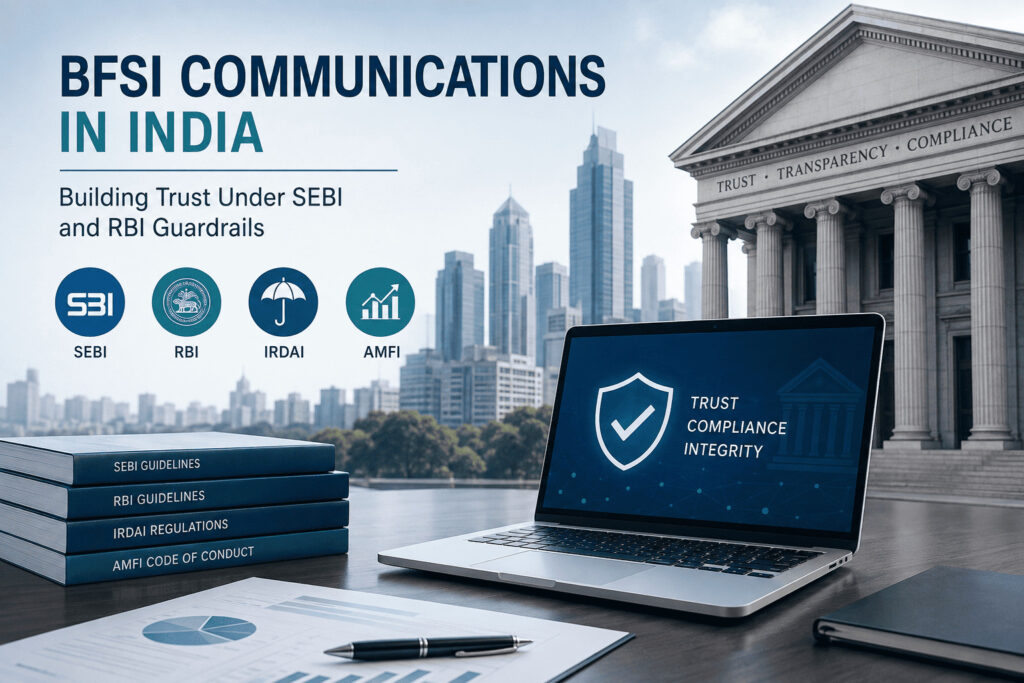
Financial services communications in India operates under constraints that don’t exist in other sectors. What a bank can say about its products, how a mutual fund distributor can position performance, what a listed NBFC can disclose about its operations — all of these are shaped by SEBI regulations, RBI guidelines, IRDAI requirements, and AMFI codes.
For communications professionals who come from other sectors, this regulatory environment is the first and most important thing to understand. For companies that ignore it, the consequences range from compliance notices to reputational damage that no PR can repair.
The regulatory framework in brief
SEBI governs listed companies, mutual funds, stockbrokers, and investment advisors. The most relevant SEBI requirements for communications professionals: material information disclosure (what must be disclosed to exchanges and when), prohibitions on price-sensitive information disclosure, and advertising guidelines for mutual funds and securities.
RBI governs banks, NBFCs, payment systems, and foreign exchange. Key communications constraints: guidance on how interest rates can be communicated, restrictions on certain deposit-related claims, and requirements around customer grievance communication.
IRDAI governs insurance. Insurance advertising and communication is subject to specific IRDAI guidelines on product claims, illustrations, and comparative advertising.
AMFI provides a code of conduct for mutual fund communication that prohibits performance-based marketing of specific schemes and requires specific disclaimers.
The communications team — whether in-house or agency — needs to either have working knowledge of these frameworks or have access to a legal reviewer who does. A press release or LinkedIn post that violates SEBI’s material information disclosure requirements is not a communications mistake. It’s a compliance violation.
What BFSI communications can do effectively within these guardrails
Leadership and executive positioning. Regulatory guardrails apply to product and performance claims. They do not prevent a bank CEO from publishing a thought leadership piece on financial inclusion, a fintech founder from commenting on digital payments policy, or an insurance MD from discussing longevity risk. Executive positioning is one of the highest-value and most underused communications tools in the BFSI sector.
Policy and regulatory commentary. BFSI companies have genuine expertise on regulation that journalists, policymakers, and business audiences value. Commentary on RBI monetary policy decisions, analysis of SEBI regulatory changes, perspectives on the evolution of UPI — these are credible, valuable, and entirely consistent with regulatory requirements. This is where BFSI companies can build thought leadership that no other sector has access to.
Customer education content. Banks, insurers, and fintechs that produce genuinely useful financial literacy content — not product marketing dressed up as education — build trust with consumers and create media-citable content that earns coverage and search visibility. The key is that the education must be genuinely useful independent of the company’s own products.
ESG and social impact reporting. For listed banks and large NBFCs, BRSR reporting is mandatory. The communications opportunity is to go beyond compliance: publish impact reports that demonstrate how lending and investment decisions align with ESG goals, with specific data and genuine transparency.
Crisis communication. BFSI crisis situations — a cyber breach, a fraud incident, a regulatory action — require particularly careful communications that are legally reviewed, factually precise, and cognisant of what must and cannot be disclosed. Companies that have pre-established relationships with financial journalists and pre-prepared crisis protocols handle these situations significantly better than those that improvise.
The trust problem that BFSI communications is really solving
Every BFSI company operates in a sector where the fundamental product is a promise — a promise to repay, to pay out on a claim, to protect and grow savings. The communications job is to make that promise credible.
Trust in financial services is built over time through consistency: consistent communication, consistent conduct, and consistent alignment between what the company says and what it does. A single breach — a mis-selling incident widely reported, a customer grievance publicly mishandled, a regulatory penalty with reputational implications — can erode years of trust-building communication.
This is why BFSI communications that focuses only on product features and market positioning misses the most important work. The most valuable communications investment for any bank, NBFC, or insurance company is the one that builds the foundational trust that makes everything else — product uptake, talent acquisition, regulatory relationships — easier.
The fintech consideration
Fintech companies operating in the BFSI space face a specific challenge: they carry the regulatory constraints of financial services without the legacy brand recognition of established banks and insurers. A fintech lending company needs to build the trust a customer places in a bank — that their money is safe and the company is credible — while operating as a relatively new brand with no branch network and no 50-year operating history.
Fintech communications that works builds this trust through: transparent communication about the regulatory framework the company operates in (RBI licensing, SEBI registration), visible risk management leadership, genuine customer testimonial content, and a track record of consistent, honest product communication that doesn’t oversell returns or understate risk.
Frequently Asked Questions
Can financial companies run campaigns comparing their products to competitors?
Comparative advertising in financial services is tightly regulated. SEBI and IRDAI have specific restrictions on comparative product claims. Any comparative communication should be reviewed by legal before publication.
How do listed BFSI companies manage communications around quarterly results?
The period before quarterly results announcement — typically defined in the company’s quiet period policy — restricts what can be said about financial performance. Communications in this window should be limited to previously disclosed information and general sector commentary, with material communications paused until the results are disclosed to exchanges.
What’s the most common BFSI communications mistake?
Making performance or return claims — explicitly or implicitly — that are not substantiated, compliant with SEBI/AMFI guidelines, or accompanied by required disclaimers. “Past performance does not guarantee future results” is not optional fine print. It is a regulatory requirement, and treating it as optional is a compliance risk.
