
Indian EdTech had its hype cycle, and the sector is living with the consequences. Companies that raised enormous rounds on the strength of pandemic-era growth metrics and aggressive marketing are now navigating a trust deficit with parents, educators, and policymakers who feel they were oversold.
In that environment, EdTech PR that leans on the old playbook — big claims, celebrity endorsements, astronomical user numbers — actively damages credibility. The communication that works in 2026 is built on specificity, honesty, and evidence.
The audiences that matter, and what they need to hear
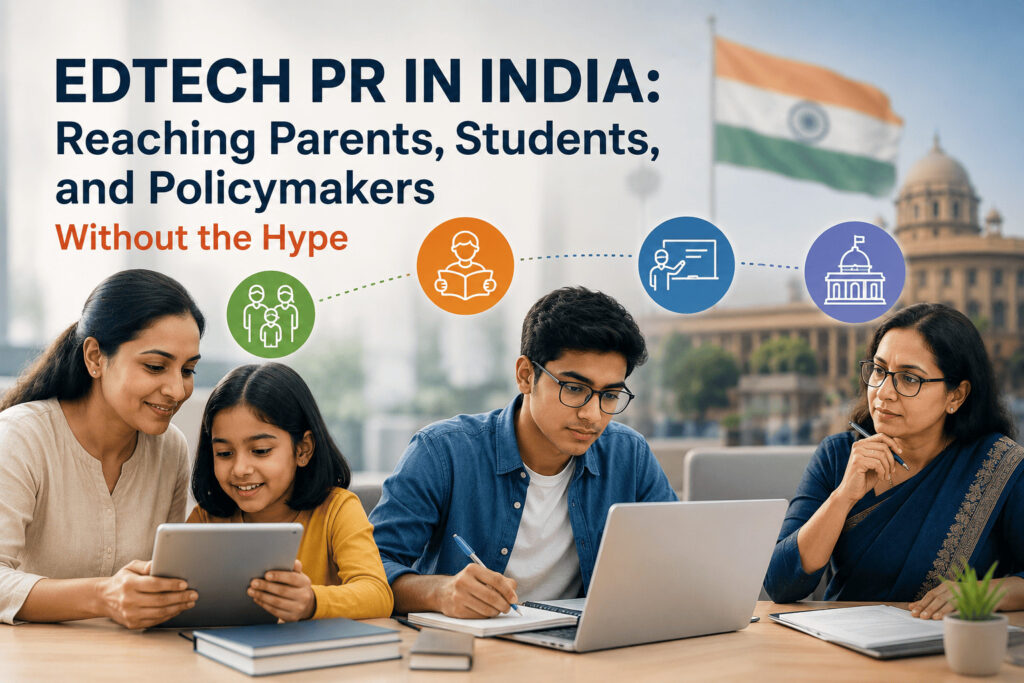
EdTech communication is harder than most sectors because the buying decision involves multiple stakeholders with different information needs and different levels of trust.
Parents are the primary buyers for K-12 EdTech. They are suspicious after years of aggressive sales calls and inflated promises. What moves them is peer testimony, outcome data (not “students improved” but “students in Class 10 using this platform improved their board scores by an average of 12 marks in a six-month period”), and transparency about how the product works and what it costs.
Students are the users and, in the higher education segment, increasingly the buyers. They respond to authentic peer voices, honest assessments of learning outcomes, and content that treats them as capable of evaluating evidence rather than as a target for aspirational messaging.
Educators and schools are the institutional channel and also the most rigorous evaluators. A schoolteacher who recommends an EdTech product to parents has staked their credibility on it. They need to see evidence of pedagogical soundness, ease of use, and institutional longevity — evidence that the company will still exist and still be investing in the product in three years.
Policymakers are increasingly relevant as the government’s National Education Policy and CBSE digital initiatives create regulatory frameworks that EdTech companies need to navigate and be seen to support. Media coverage in policy-adjacent publications and participation in government-adjacent forums matters for this audience.
What EdTech PR should look like in 2026
Outcome data, published honestly. The companies that will earn lasting trust in EdTech are the ones that publish their outcome data — including the parts that are mixed or show room for improvement. A company that publishes an annual impact report with real learning outcome data, methodology explained, and honest interpretation is doing something almost no EdTech company in India does. That differentiation is a communications asset.
Teacher voices, not just student testimonials. Parent and student testimonials are standard and, after years of EdTech advertising, somewhat discounted. Teacher endorsements carry more weight because teachers are seen as independent evaluators rather than satisfied customers.
Media beyond the startup press. Inc42 and YourStory cover EdTech funding and growth stories. But the audiences that buy EdTech — parents, teachers, school administrators — don’t read startup media. They read The Hindu, Indian Express, Times of India, and regional newspapers. They watch education-specific YouTube channels and listen to parent community podcast discussions. An EdTech PR strategy that’s entirely focused on startup media is speaking to investors and fellow founders, not to buyers.
Policy engagement, not just media. Being visible at NEP implementation discussions, contributing to CBSE’s digital initiatives conversations, and being cited in government education reports builds a credibility layer that media coverage alone can’t produce. This requires sustained relationship building with MHRD-adjacent forums, not just a one-time press conference.
The Kotak Education Foundation model
Blue Buzz’s work with Kotak Education Foundation — for their scholarship and education access programmes — demonstrates what education sector PR looks like when it’s built on genuine impact rather than product claims. The communications led with human stories (specific scholarship recipients, specific life changes, specific school improvements), used a mainstream-plus-education media mix, and earned Best PR Campaign Gold at E4M 2025 for its work.
The lesson generalises: education communications that leads with the human outcome, supported by specific data and real voices, earns coverage and trust that product-led communications cannot.
Frequently Asked Questions
How does EdTech PR change after the hype cycle?
The emphasis shifts from growth metrics (users, downloads, GMV) to outcome metrics (learning improvement, teacher adoption rates, student retention). The publications that matter shift from financial news to education press and mainstream broadsheets. And the tone shifts from aspiration to evidence.
Is PR useful for EdTech companies at an early stage?
For B2C EdTech, early-stage PR is most effective when there’s a genuine outcome story to tell — even from a small pilot. For B2B EdTech selling to schools and institutions, early-stage PR is less urgent; the sales cycle runs through direct relationships and reference accounts, not media coverage.
How should EdTech companies handle negative press coverage?
Respond directly and specifically to factual errors. For opinion pieces critical of the sector, the most effective response is a well-evidenced counter-narrative published in the same or comparable publication — not a press release rebuttal.
