
Author: Puneet Bhagchandani | Vice-President, Blue Buzz
Mumbai has more PR agencies than most clients realise. Boutiques, mid-size shops, network agency outposts, digital-first hybrids, freelance consultants operating as agencies — the options run into the hundreds. Choosing well is not about finding the most impressive pitch deck. It’s about finding the team that will actually move your business.
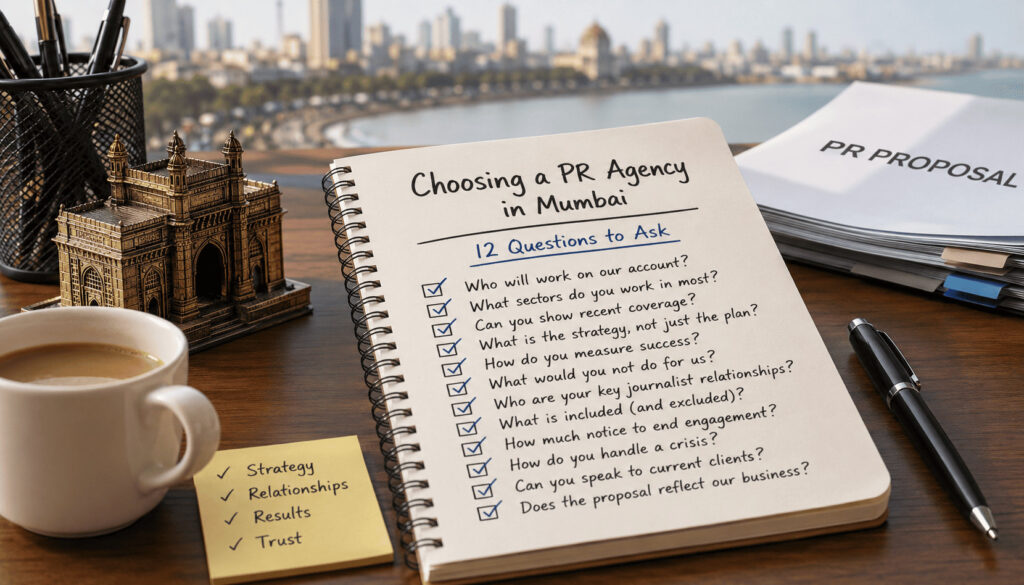
These 12 questions, asked directly and evaluated honestly, will do more due diligence than most RFP processes.
Before the pitch
1. Who will work on our account day to day?
This is the single most important question, and the one most agencies are evasive about. The senior person who pitches you — the founder, the managing director, the head of strategy — is often not the person who runs your account on a Tuesday morning. Ask specifically: name and seniority of the account lead, how many other accounts they carry, and when you’d have direct access to the most senior person.
2. What sectors do you work in most?
Sector specialisation matters more than general PR experience. An agency that works primarily in consumer and FMCG will have weaker technology or BFSI journalist relationships, regardless of their overall track record. Ask for three to five clients in your sector, not their best-known clients overall.
3. Can you show us coverage you've earned in the last 90 days?
Recent work is more reliable than case studies from two years ago. Ask to see actual coverage — links, screenshots, publication names — from recent engagements in your sector. If they can’t produce it quickly, that’s information.
During the pitch
4. What is the strategy, not just the plan?
A plan is a list of activities (press releases, media meets, features). A strategy is a point of view on what story will work for your company and why. Any agency can produce a plan. The ones worth hiring can tell you what angle will actually get a journalist to respond, and why that angle fits your business at this moment.
5. How do you measure success?
If the answer leads with “coverage count” or “reach” or “AVE” (Advertising Value Equivalent), treat that as a red flag. AVE is a discredited metric. Good agencies measure against business outcomes: how coverage is moving brand recall, inbound lead quality, share of voice in your sector, or search visibility.
6. What would you not do for us?
This is an unusual question, and a revealing one. Agencies that have a point of view — on which publications are worth targeting, which angles won’t work, which tactics are a waste of budget — are more likely to give you honest counsel. Agencies that agree with everything are likely to execute without advising.
7. Who are your key journalist relationships in our sector?
You don’t need a full list. Ask for three names of journalists they have genuine relationships with who cover your space. Then, separately, check those journalists’ recent coverage to see if the agency’s clients have been quoted there. It takes ten minutes and tells you a lot.
On pricing and process
8. What is included and explicitly excluded in the retainer?
Retainer scope is where most client-agency conflicts originate. Ask for a written scope of work that specifies: what’s delivered monthly, what’s billable separately, what the revision and approval process looks like, and what happens when you need something outside the original scope.
9. How much notice is required to end the engagement?
Standard is 30 to 60 days. Some agencies ask for 90 days. Know this before signing — it determines your exit options if the relationship isn’t working.
10. How do you handle a crisis?
Every agency will say they do crisis communications. Ask specifically: who leads it, what the response protocol looks like in the first four hours, and whether they have a documented crisis communication framework. The answer reveals how prepared they actually are.
After the pitch
11. Can you speak to two or three current clients?
References are standard practice in most professional services and underused in PR. A five-minute call with a current client — not a testimonial on a website — tells you how the agency performs on a normal week, not just their best moments.
12. Does the proposal reflect your actual business?
A proposal that could have been written for any company in your sector, with your name swapped in, is a signal that the agency pitched rather than listened. The best proposals contain something specific to your company — a competitive observation, a media angle, a sector trend — that shows they did genuine work before the meeting.
Frequently Asked Questions
Should we run a formal RFP or just have conversations?
For mandates above ₹2 lakh per month, a structured process with two or three agencies is worth the time. Below that, two informal conversations and reference checks are usually sufficient.
How long should an agency evaluation take?
Two to three weeks from first conversation to signed agreement is achievable and reasonable. Longer processes rarely improve the outcome and can signal indecision that complicates the agency relationship from the start.
Is it reasonable to ask for a paid trial project?
Yes, and good agencies will agree to it. A paid trial is fair to both sides — the agency isn’t working for free, and you see real work before committing to a retainer.
