
Author: Neha K Bisht | Founder & CEO, Blue Buzz
Every founder eventually asks the same question: do we need a PR agency on retainer, or just for this one launch? The honest answer is that neither model is universally right. The right one depends on where your company is, what you need from communications right now, and what you can realistically sustain.
What each model actually means
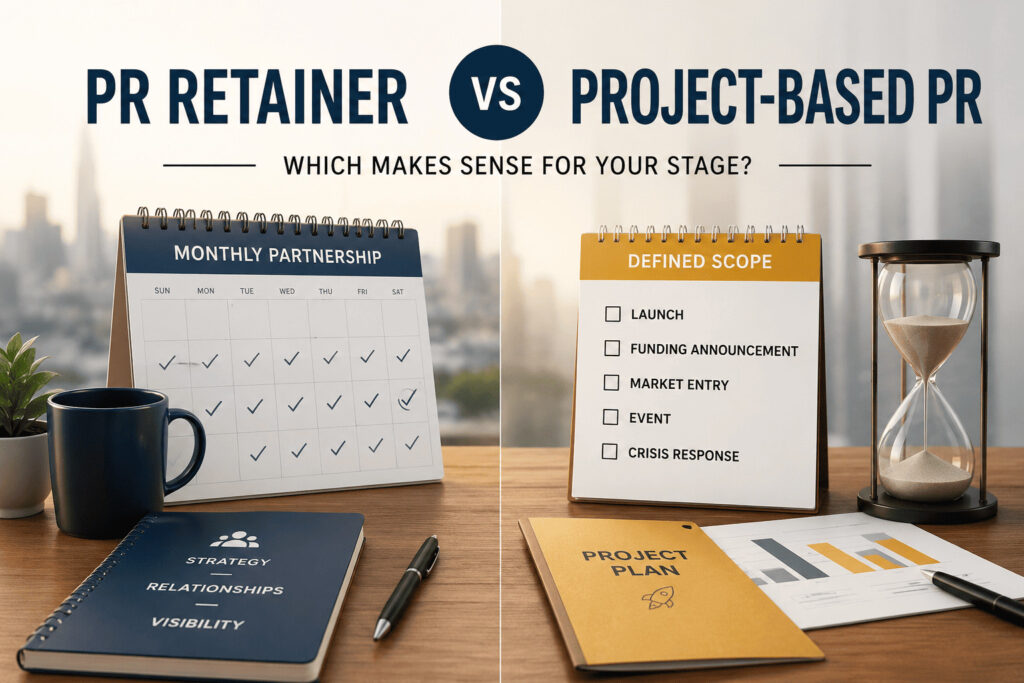
A PR retainer is a monthly fixed engagement. The agency keeps a defined scope of work running every month — media relations, story development, executive positioning, incoming press requests — and you pay a fixed fee regardless of how much coverage lands in a given month. The agency is, in effect, your external communications function.
Project-based PR is time-bound. You engage an agency for a specific event — a funding round, a product launch, a market entry, a crisis — and the engagement has a defined start and end. Fees are fixed against that scope.
When a retainer makes sense
Retainers work best when communications is a continuous need, not a periodic one. If any of the following are true, a retainer is likely the right model:
You’re building a category. If your company is creating a new market or repositioning an existing one, that work takes 12 to 18 months of consistent narrative development. No single project will do it.
You have an active executive who wants to be visible. Thought leadership — a LinkedIn presence, contributed columns, speaking nominations, journalist relationships — requires sustained effort. It cannot be switched on for a launch and off again.
You’re in a regulated or high-scrutiny sector. BFSI, healthcare, and AI companies face ongoing reputational scrutiny. Reactive communications — handling incoming press queries, monitoring sentiment, advising on statements — needs an agency that already knows your business.
You’ve raised a Series A or beyond. At this stage, investor expectations, talent acquisition, and enterprise sales cycles all benefit from consistent media presence. A retainer is now a growth investment, not a marketing expense.
When a project makes sense
Project-based PR works well in three specific situations:
You’re pre-Series A and cash-constrained. A well-executed project — one strong funding announcement, one product launch — can establish your brand in the media landscape without committing to an ongoing monthly fee. Use the project to build a coverage base, then evaluate whether a retainer is warranted.
You have a single high-stakes moment. A GCC centre launch, a senior leadership appointment, an India market entry: these are concentrated events with a defined media window. A project is the right scope.
You want to test an agency before committing. A project is a low-risk way to evaluate fit — how they think, how they work, whether they understand your sector. If it goes well, the conversation about a retainer is much easier.
The hybrid model
Many companies find a middle path: a lighter retainer (covering core media relationships and reactive communications) combined with project top-ups for major moments. This gives the agency enough continuity to be genuinely useful while containing monthly costs.
At Blue Buzz, this is a common starting structure for growth-stage companies — a three to six month initial retainer to build the foundation, then a review of what’s working before deciding on scope and cadence going forward.
The question that matters most
Before choosing a model, answer this: what does communications need to achieve in the next six months? If the answer is “close a round,””launch a product,” or “enter a new city,” a project may be enough. If the answer is “become the recognised leader in our category” or “build a media presence that supports enterprise sales,” that’s retainer work.
The model follows the goal. Choosing the model before defining the goal is how companies end up paying for coverage they don’t need.
Frequently Asked Question
What is a typical PR retainer commitment period in India?
Most agencies ask for a minimum of three months, with six months being the more common starting point. Twelve-month commitments typically come with a better rate and allow for more meaningful work.
Can a retainer be paused?
Some agencies allow it; most don’t. It’s worth clarifying before signing. A pause clause that requires 30 to 60 days notice is standard where it exists.
What happens at the end of a project engagement?
Coverage placed during the project stays live. Relationships the agency built with journalists are theirs, not yours. Media lists, strategy documents, and coverage reports should be handed over — confirm this in the agreement before work begins.
How Much Does a PR Agency Cost in India 2026? Pricing Guide
Understand real PR pricing in India, compare retainers vs project-based models, and learn how founders choose the right PR investment.
Read Pricing Guide →