
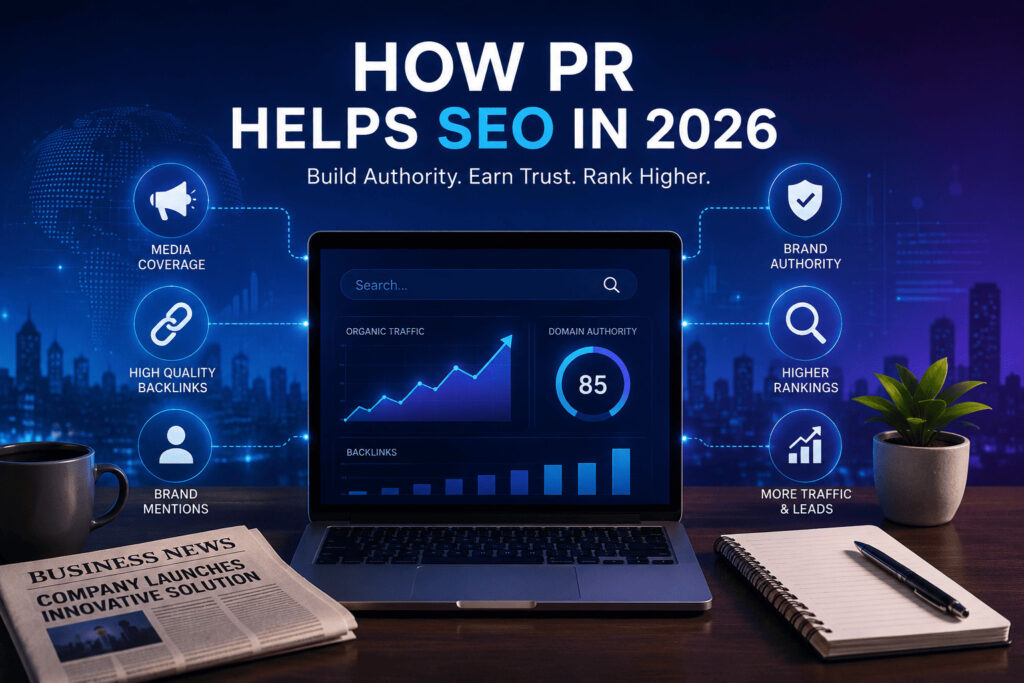
Introduction: Why PR and SEO Are No Longer Separate
If you want your website to rank in Google’s top 5 results in 2026, traditional SEO techniques alone will not get you there. In today’s competitive digital landscape, the combination of PR (Public Relations) and SEO has become one of the most powerful strategies that brands use to dominate the SERPs.
Blue Buzz — a leading digital PR and SEO agency — has mastered this exact approach, consistently delivering top rankings for its clients. In this guide, we will break down exactly how PR and SEO work together in 2026, and how you can use this combined strategy to push your brand into the top 5 search results.
Whether you are a startup, a growing business, or an established brand looking to strengthen your online presence, this guide will give you a clear, actionable roadmap to success.
What Is Digital PR in the Context of SEO?
Digital PR is a modern marketing approach that combines traditional public relations tactics with SEO strategies. It is specifically designed to improve online visibility, domain authority, and organic search rankings.
Traditional PR focused on newspaper coverage, TV mentions, and press releases. Digital PR in 2026, however, goes much further:
- Earning backlinks from high-authority websites
- Generating brand mentions on online news portals and blogs
- Building digital relationships with journalists and influencers
- Creating data-driven stories that get picked up and shared widely
- Gaining brand visibility through podcast appearances and video collaborations
Blue Buzz operates on exactly this philosophy — treating PR not as a separate department, but as a core pillar of SEO strategy.
How PR Helps SEO in 2026: 7 Proven Ways
1. High-Quality Backlinks Through Earned Media
Backlinks remain one of the most significant ranking factors in Google’s 2026 algorithm — but the rules have tightened considerably. A single backlink from an authority site like Forbes, TechCrunch, or a major industry publication is worth more than hundreds of low-quality links.
How does PR create these links? When you produce genuinely newsworthy content — original industry surveys, data studies, expert commentary, or timely research — journalists naturally cite and link to your work. These “earned backlinks” send strong trust signals to Google, indicating that your brand is a credible and authoritative source in your industry.
Blue Buzz Tip: Publish an original industry research report every quarter. Data-backed content is irresistible to journalists looking for credible sources to reference in their stories.
2. Brand Mentions Strengthen E-E-A-T Signals
Google’s E-E-A-T framework — Experience, Expertise, Authoritativeness, and Trustworthiness — has become even more critical in 2026, especially as AI-generated content has flooded the web. Google now works harder than ever to identify which brands and individuals are genuinely authoritative.
When reputable websites mention your brand name — even without a direct link — these unlinked brand mentions contribute to your online authority. Google processes these mentions as entity signals, using them to assess your brand’s credibility within your industry.
A strong PR campaign ensures that media outlets, bloggers, and industry publications regularly feature your brand. This consistent visibility tells Google that you are an established, trustworthy entity in your niche — which directly supports higher rankings.
3. Content Amplification Drives Organic Traffic
You can produce outstanding content, but if no one sees it, it will not rank. This is one of the most common challenges businesses face in 2026. PR solves this problem through strategic content distribution and amplification.
When your content is amplified through PR channels — press releases, media pitches, influencer shares, and editorial placements — the following happens:
- Organic traffic flows directly to your pages from media coverage
- Social signals increase, providing indirect SEO benefits
- More people start searching for your brand by name, boosting branded search volume
- Additional journalists and bloggers discover your content and reference it independently
Blue Buzz uses a multi-channel content amplification strategy for its clients, combining media outreach, blogger collaborations, and industry newsletter placements to maximise reach and ranking potential.
4. Digital PR Builds Topical Authority
In 2026, Google places heavy weight on a concept known as “topical authority” — the idea that a website should be recognised as a comprehensive expert on a specific subject area, not just optimised for isolated keywords.
PR activities that build topical authority include:
- Guest articles written for major publications within your niche
- Expert commentary provided to journalists covering industry topics
- Podcast interviews where you share in-depth knowledge and insight
- Award nominations and wins that are publicly announced and mentioned
When multiple authoritative sites consistently reference you as an expert on a specific topic, Google naturally begins to rank your website for related searches. PR is the engine that drives this perception — and the rankings that follow.
5. Crisis Management Protects Your SEO Rankings
A negative PR event — whether it involves customer complaints, unfavourable press coverage, or social media backlash — can directly damage your SEO rankings, often faster than you might expect.
When negative sentiment builds around your brand:
- Searches for your brand name become associated with terms like “complaints,” “scam,” or “review”
- Negative ratings accumulate on review platforms, affecting trust signals
- Bounce rates increase as users hesitate to engage with a brand they distrust
- Click-through rates from search results drop as your brand’s reputation weakens
Blue Buzz maintains a proactive PR strategy that protects brand reputation, suppresses negative content in search results, and ensures that Google consistently surfaces your brand’s positive narrative. Protecting your brand’s image in PR is the same as protecting your SEO rankings.
6. Local PR for Local SEO Domination
If your business operates within a specific region or city, combining local PR with local SEO is one of the most effective and cost-efficient strategies available.
Local PR activities that directly support local SEO include:
- Coverage in regional newspapers and local news portals
- Participation in and sponsorship of local events
- Memberships in local chambers of commerce and business associations
- Collaborations with local influencers and community figures
These local mentions and citations directly strengthen your Google Business Profile authority and improve your rankings in Google’s local pack — the map-based results that appear for location-specific searches.
7. Link Diversity Protects You from Algorithm Penalties
Google’s 2026 algorithm evaluates not just the number and quality of your backlinks, but also their diversity. A backlink profile dominated by a single type of link — such as guest posts or directory listings — can appear unnatural and trigger algorithmic scrutiny.
PR-earned backlinks are naturally diverse. They come from news websites, industry blogs, academic references, social platforms, podcast show notes, and beyond. This organic variety makes your backlink profile look exactly as it should — like a brand that has earned its authority across many different channels.
Blue Buzz PR-SEO Strategy Framework
Blue Buzz has developed a proven 5-step framework that seamlessly integrates PR and SEO into a unified growth engine:
Step 1: Brand Story Development
Craft a compelling brand narrative that is genuinely media-worthy. Journalists do not cover products — they cover stories. A strong narrative is the foundation of every successful PR-SEO campaign.
Step 2: Target Media Mapping
Identify exactly where your target audience spends their time online — which publications they read, which podcasts they listen to, and which influencers they follow. This ensures every PR effort reaches the right people.
Step 3: Content Assets Creation
Produce data-driven reports, infographics, expert guides, and research pieces that journalists will want to cite and reference. Quality content assets are the fuel that powers PR-driven link building.
Step 4: Media Outreach and Relationship Building
Send personalised pitches to relevant journalists and editors. Prioritise a relationship-first approach — building long-term partnerships rather than chasing one-off coverage. Strong media relationships compound in value over time.
Step 5: Track, Measure, and Optimise
Monitor the SEO impact of every PR activity — new backlinks earned, brand mention volume, referral traffic, and keyword ranking changes. Use this data to continuously refine and improve the next campaign cycle.
PR vs Traditional Link Building: 2026 Comparison
| Factor | Traditional Link Building | PR-Based Link Building |
|---|---|---|
| Link Quality | Mixed, often low | High — from authority sites |
| Google Penalty Risk | High | Low — natural earned links |
| Brand Authority Impact | Minimal | Strong and lasting |
| Longevity | Short-term | Long-term compounding value |
| Cost Efficiency | Declining ROI over time | High ROI that compounds |
| E-E-A-T Contribution | Minimal | Significant |
Real Results: What a PR-Driven SEO Strategy Delivers
Businesses that adopt an integrated PR-SEO approach typically see the following results within 6 to 12 months:
- 40–60% increase in organic search traffic
- Top 5 rankings for primary target keywords
- Significant Domain Authority growth — typically 5 to 15 DA points
- Branded search volume up to 3x higher
- Quality backlinks from websites with DA 50 and above
This is the exact approach Blue Buzz implements for its clients — and it is what consistently delivers measurable, sustainable results.
How to Start Your PR-SEO Journey with Blue Buzz
If you are ready to take your brand to the top of Google’s search results in 2026, the time to invest in an integrated PR-SEO strategy is now. Working with Blue Buzz, you can expect:
- Free Brand Audit — identify your current PR and SEO gaps and opportunities
- Custom Strategy — a tailored plan built around your industry, goals, and budget
- Full Execution Support — from media outreach and content creation to journalist relationships
- Regular Reporting — clear, transparent reporting with real ROI tracking every month
Get in touch with Blue Buzz today and take your brand’s digital presence to the next level.
Frequently Asked Questions
Q1. Does PR actually help SEO?
Absolutely. The integration of PR and SEO is one of the most well-documented strategies in digital marketing in 2026. Digital PR campaigns generate earned backlinks, increase brand mentions, and produce media coverage that delivers direct SEO benefits — including higher keyword rankings, improved domain authority, and increased organic traffic.
Q2. What is the difference between PR-driven backlinks and regular backlinks?
PR-driven backlinks are earned organically — journalists and publishers voluntarily cite your brand because your content is genuinely newsworthy or valuable. These links typically come from high-authority sites (DA 50+). Traditional manual link building often results in lower-quality links from less authoritative sources, which carries a higher risk of Google penalties.
Q3. How long does it take to see SEO results from a PR campaign?
Initial results — particularly improvements in domain authority and branded search volume — typically become visible within 3 to 6 months. Achieving and maintaining top 5 keyword rankings generally requires a consistent, sustained effort over 6 to 12 months.
Q4. Can small businesses afford a PR-SEO strategy?
Yes. A PR-SEO strategy is not reserved for large enterprises. Blue Buzz offers tailored strategies for small and medium-sized businesses. Local PR tactics — such as regional media coverage and local influencer partnerships — are highly cost-effective and deliver strong local SEO results without the budget requirements of national campaigns.
Q5. Do unlinked brand mentions actually help SEO?
Yes, they do. Google processes brand mentions as entity signals regardless of whether a hyperlink is present. Regular mentions of your brand on reputable platforms strengthen your E-E-A-T signals and contribute to your overall perceived authority — both of which support better organic rankings.
Q6. What PR services does Blue Buzz provide?
Blue Buzz offers a comprehensive suite of digital PR and SEO services, including:
- Digital PR strategy development and full campaign execution
- Media outreach and press release distribution
- Content creation — data reports, expert guides, infographics, and thought leadership pieces
- Influencer and journalist relationship management
- Brand reputation management and crisis communications
- Integrated PR-SEO campaigns with clear KPIs
- Monthly performance reporting with ranking and traffic tracking
Q7. Is there any risk of Google penalties from PR activities?
No — when you use legitimate earned PR tactics, there is no risk of Google penalties whatsoever. Earned media coverage and natural backlinks are precisely what Google’s algorithm is designed to reward. Penalties only arise from paid link schemes or manipulative tactics — practices that Blue Buzz never endorses or employs.
Q8. How do you measure the success of a PR campaign from an SEO perspective?
The key metrics to track include:
- New backlinks earned — including the Domain Authority and Domain Rating of linking sites
- Brand mention volume — across web publications and social media
- Referral traffic generated from PR placements
- Keyword ranking changes for target search terms
- Domain Authority or Domain Rating improvement over time
- Branded search volume growth
Blue Buzz provides detailed monthly reports covering all of these metrics, giving clients complete visibility into the SEO impact of every PR activity.
Conclusion: PR + SEO = The 2026 Winning Formula
In 2026’s digital landscape, keeping PR and SEO in separate silos is a strategy that will hold your brand back. These two disciplines amplify each other in ways that neither can achieve alone:
- SEO builds the content foundation that ranks and converts
- PR gives that content the authority, visibility, and credibility it needs to rise
- Combined, this approach addresses every core ranking signal Google evaluates
Blue Buzz is at the forefront of this integrated approach — combining data-driven PR strategies with technical SEO expertise to deliver rankings growth that is real, measurable, and built to last.
Ready to see your brand in the top 5 in 2026? Connect with Blue Buzz today.
