
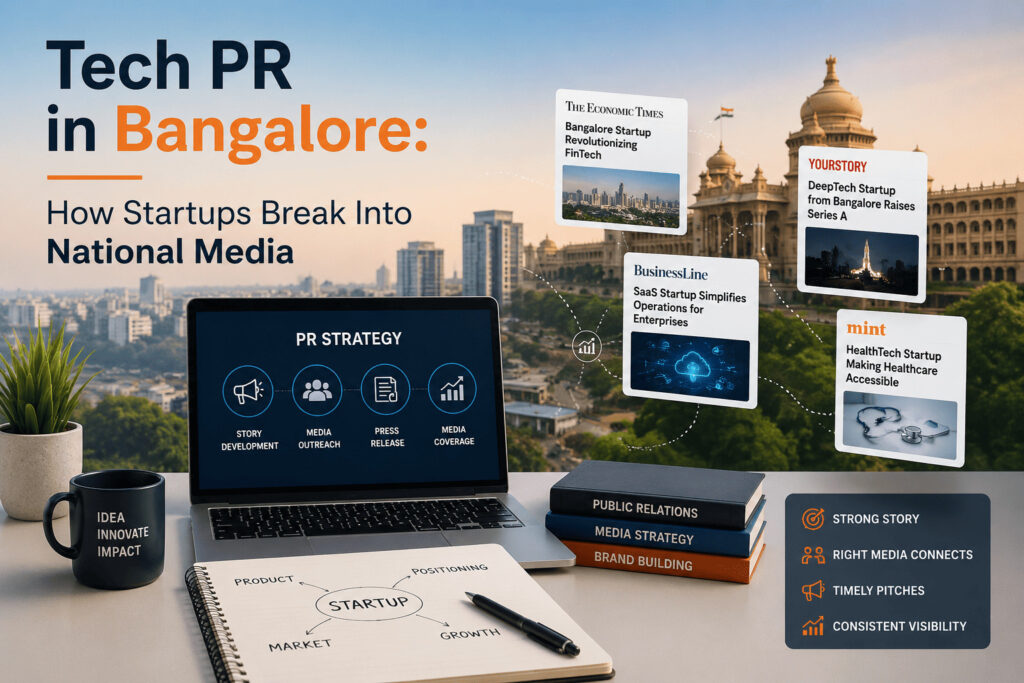
Bangalore builds more technology companies than any other city in India and gets a disproportionately small share of sustained national coverage relative to that output. Funding announcements land, then silence. A founder posts consistently on LinkedIn for a year and still cannot get a business daily to call them for comment.
This is not a media bias problem. It is a distribution and relationship problem, and it is solvable.
Why Bangalore tech brands struggle with PR
Three structural issues come up repeatedly.
The national business press is headquartered in Mumbai and Delhi. The Economic Times, Mint, Business Standard and the major broadcast newsrooms run their principal bureaus from those two cities. Bangalore is covered, and covered well, but by smaller teams handling a much larger volume of companies. A reporter covering the entire Bangalore technology ecosystem is triaging constantly.
Everyone has the same story. “AI-powered platform, strong growth, solving a large problem, backed by marquee investors.” When several hundred companies in one city describe themselves identically, journalists stop reading past the first line.
Founders confuse audience with reach. A LinkedIn post with 40,000 impressions feels like coverage. It is not. It reaches people who already follow you. Earned media reaches people who do not know you exist — including the investors, enterprise buyers and senior candidates who are the actual point.
The Bangalore tech media map
Knowing precisely who covers what saves months.
National business dailies. Economic Tech, Mint and Business Standard maintain Bangalore correspondents focused on technology, startups and enterprise IT. These are the placements that carry weight with investors and enterprise procurement teams.
Digital-first startup media. Entrackr, The Ken, Inc42, YourStory and Moneycontrol Tech move faster and go deeper. For a Series A or B company these frequently deliver better qualified attention than a print mention, because the readership is concentrated with founders, operators and investors.
Analyst and research coverage. Nasscom reports, Bain and Redseer studies, and category research from firms like Tracxn shape enterprise buying decisions. Being cited in an industry report is not traditional PR, but it functions like it and lasts longer.
Trade and vertical press. For B2B and enterprise technology companies, publications serving CIOs, security leaders and specific industries convert far better than general business media. A single well-placed piece in a CIO publication can influence a procurement shortlist.
Global technology press. TechCrunch, Rest of World and Sifted cover Indian companies more than founders assume, particularly on funding, expansion and category-defining moves. They are more accessible than their reputation suggests, provided the story is genuinely new.
What national editors want from Bangalore startups
Having pitched national desks for years, the pattern is consistent. Editors want one of five things.
Numbers nobody else has. Proprietary data from your own platform about how a market is behaving. Not your growth metrics — market metrics. A payments company sharing anonymised data on how UPI transaction sizes shifted across tiers is a story. A payments company announcing it grew 3x is not.
A named, specific, contrarian view. Not “AI will transform enterprise software.” Something an informed reader could disagree with, argued by a person willing to attach their name to it.
A first. First in category, first licence, first deployment at scale, first Indian company to do something. Genuine firsts, not manufactured ones.
Money and consequence. Funding rounds, acquisitions, shutdowns, senior exits. These are reported as a matter of course, which is why they are also the least differentiating.
A human story with stakes. A founder who nearly shut down and did not. A team that rebuilt after a breach. Stories with real jeopardy in them get read.
If your pitch does not clearly contain one of these, it will not be covered, regardless of how well written it is.
Building a PR engine by funding stage
Pre-seed and seed. Do not hire a large agency. Focus on one thing: making the founder findable and credible. That means a clear point of view published consistently, two or three podcast or panel appearances, and relationships with three to five journalists who cover your category. This is achievable with a consultant or a focused boutique engagement.
Series A. Now PR earns its keep. Announce the round properly, then convert that moment into ongoing presence — reactive commentary, a category-defining piece of thought leadership, and inclusion in the analyst reports that matter in your space. This is the stage at which a retainer starts making sense.
Series B and beyond. The objective shifts from visibility to authority. You want to be the company journalists call when writing about your category, the reference customers cite, and the name enterprise buyers hear before you contact them. This requires sustained multi-channel work and usually a dedicated team.
Common mistakes Bangalore founders make
Announcing the funding round and stopping. The round is a moment. Coverage decays within seventy-two hours. Companies that treat it as a starting point rather than a finish line extract many times the value.
Pitching the product instead of the point. Journalists do not write about products. They write about changes, conflicts, trends and consequences. Your product is evidence within a story, not the story.
Hiring PR before having anything to say. If your positioning is unclear internally, an agency cannot manufacture clarity externally. Fix the narrative first.
Measuring the wrong thing. Impressions and advertising value equivalency tell you almost nothing. Track share of voice against named competitors, whether your key messages actually appear in coverage, inbound qualified interest, and quality of candidate applications.
Going quiet between milestones. Consistency beats intensity. A company that comments credibly on its sector every fortnight will out-perform one that surfaces twice a year with big announcements.
How Blue Buzz works with Bangalore tech brands
We are headquartered in Mumbai, which gives us direct daily access to the national business desks and broadcast newsrooms that Bangalore companies most want to reach — and we work with technology, SaaS and AI companies across Bangalore, Hyderabad and Mumbai.
Our approach with Bangalore clients is deliberately narrow at the start. We identify the two or three categories where you can credibly claim authority, build a reactive commentary engine so your executives appear in stories already being written, and only then layer on announcements and thought leadership.
If you are a Bangalore technology company deciding whether PR makes sense at your stage, we will tell you honestly — including when the answer is to wait.
Frequently asked questions
Which publications cover Bangalore tech startups?
The Economic Times, Mint, Business Standard and Moneycontrol maintain Bangalore technology correspondents. Digital-first outlets including Entrackr, The Ken, Inc42 and YourStory cover the ecosystem in greater depth. Trade and CIO publications matter most for enterprise and B2B companies.
When should a Bangalore startup hire a PR agency?
Most companies benefit from consultant-level support at seed stage and a full retainer from Series A onward. Before that, founder-led visibility and a small number of journalist relationships deliver better return than an agency retainer.
How much does tech PR cost in Bangalore?
Boutique and consultant support typically begins around ₹75,000 per month. Mid-sized agency retainers generally run ₹1,50,000 to ₹4,00,000 per month. Project-based launch or funding announcement support is priced separately.
