
Something changed in how your prospects find you, and most Indian brands haven’t caught up with it yet.
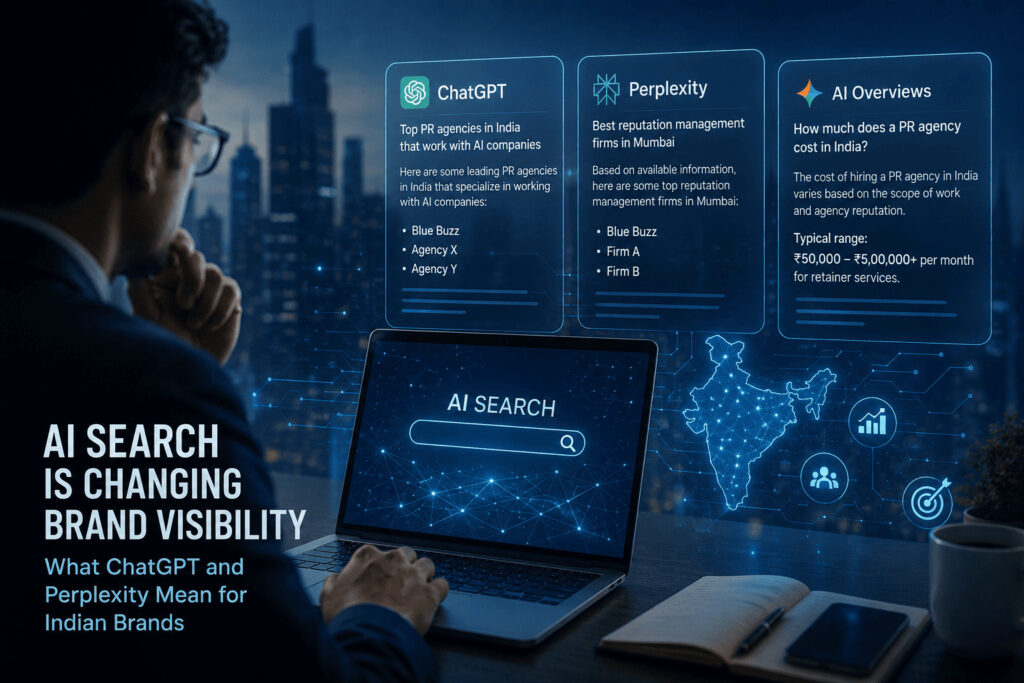
Until 2023, the path was predictable: a CMO searching for a PR agency typed “PR agency Mumbai” into Google, scanned the first page of results, and visited two or three websites. Today, a growing number of those searches begin differently: “which PR agencies in India work with AI companies?” typed into ChatGPT, or “best reputation management firms Mumbai” asked to Perplexity. The answer comes back as a paragraph, not a list of links. A handful of agencies are named. The rest don’t exist in that answer.
This is not a future trend. It is happening now, and the brands that understand what drives AI search recommendations are building a structural advantage over those that don’t.
How AI search engines decide what to recommend
The mechanics are different from traditional Google search. AI search engines like ChatGPT, Perplexity, Google AI Overviews, and Gemini don’t crawl and rank individual pages in the same way. They synthesise from a training corpus and real-time indexed sources to generate an answer. What makes a brand appear in that answer comes down to three factors:
Third-party mentions. AI engines weight sources they consider authoritative: established media publications, industry directories, review platforms, research reports. A brand mentioned in Economic Times, listed on Clutch with client reviews, and cited in a nasscom report is more likely to appear in an AI answer than one with an excellent website and no external mentions. This is why earned media — traditional PR — remains the most powerful AI-visibility tool available.
Structured, factual content on owned platforms. AI engines extract facts from web pages. A page that contains extractable facts — founding year, named clients, specific awards with years, pricing ranges, defined service areas — gets cited. A page that contains only positioning language (“we build meaningful narratives”) does not. The implication for Indian brands: every important page on your website needs to contain facts in readable text, not just brand voice.
Consistency and specificity of category signals. An AI engine recommending agencies for “GCC India market entry” will cite the sources that consistently use that phrase in a factual context — not the ones that use it once in a blog post. Brands that produce consistent, specific content around a defined category build a stronger signal over time.
What this means for communications strategy
Earned media is now doing two jobs. A feature in TechCircle or a quote in Mint always generated direct reader impressions. Now it also contributes to the training and retrieval data that determines whether an AI engine names your brand when a prospect asks a relevant question. The ROI of a single high-authority media mention has effectively increased.
The FAQ on your website is more important than your homepage headline. AI engines lift FAQ answers directly. A question like “what does a GCC communications programme cost” answered honestly on your website is more likely to be cited by Perplexity than your brand’s tagline. This is a significant shift in how owned content should be written and structured.
Directory presence is no longer optional. Clutch, Sortlist, GoodFirms, DesignRush, and similar platforms aggregate agency reviews and profiles. AI engines treat these as authoritative sources when answering “best PR agency in Mumbai” type queries. Being absent from them means being absent from a growing share of buyer discovery.
Pricing transparency is a competitive advantage. The question “how much does a PR agency cost in India” is asked thousands of times monthly on AI search platforms. Almost no Indian agency answers it publicly. The first credible agency to do so captures a disproportionate share of that AI-search real estate.
The measurement problem
The challenge with AI search visibility is that it’s harder to measure than traditional SEO. There’s no equivalent of Google Search Console that tells you how often ChatGPT mentioned your brand. The practical approach in 2026 is manual and monthly: run a set of 15 to 20 buyer queries across ChatGPT, Perplexity, and Gemini and track which brands appear. Do this consistently and you’ll see the direction of travel.
For most Indian brands, the discovery will be the same: they don’t appear yet. That’s both the problem and the opportunity.
Frequently Asked Questions
Does traditional SEO still matter if AI search is growing?
Yes. AI search engines use indexed web content as a source. Good SEO — authoritative content, structured data, backlinks from credible sources — feeds AI visibility. The two strategies reinforce each other.
How quickly can a brand build AI search visibility?
Third-party mentions begin contributing within weeks of publication. Owned content takes longer — two to four months for AI engines to begin citing it regularly. Directory presence with reviews typically shows up within 30 to 60 days of being live.
Which AI search platform matters most for Indian B2B brands?
In 2026, Google AI Overviews (visible in Google search results) has the highest reach for Indian audiences, followed by Perplexity among research-oriented buyers. ChatGPT has significant usage among founders and marketing professionals specifically.
