
At some point, every growing company faces this question. The PR agency is working, the team has grown, and someone in the leadership meeting asks: should we bring this in-house? Or the reverse — the in-house comms person is stretched, coverage has stalled, and the question is whether an agency would do it better.
Neither model is universally right. The answer depends on what your communications function needs to do and what your company can sustain.
What in-house PR actually costs
The honest cost of an in-house communications function is higher than most companies calculate when they first consider the switch.
A mid-level communications manager in Mumbai with three to five years of experience commands ₹8 to ₹14 lakh per annum in 2026. A senior communications head with ten years of sector-relevant experience and strong journalist relationships commands ₹18 to ₹35 lakh. Add employer PF, gratuity, health cover, tools (media databases, monitoring platforms, wire distribution), and the real cost of a capable senior hire sits at ₹25 to ₹45 lakh annually — before any PR spend itself.
A PR agency retainer at ₹1.5 to ₹3 lakh per month — ₹18 to ₹36 lakh annually — buys access to a team with varied sector expertise, established journalist relationships, and senior strategy. The cost comparison is closer than it looks on the surface.
What an agency does better
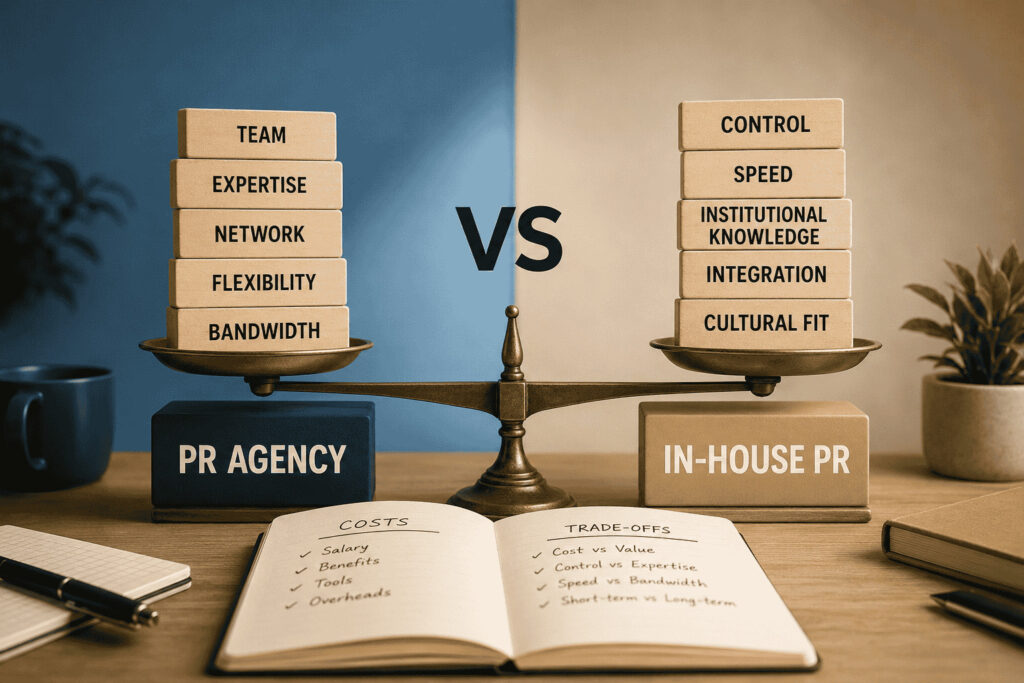
Breadth of relationships. A good agency has active relationships across 50 to 200 journalists across sectors, publication tiers, and cities. An in-house person, however capable, builds relationships more slowly and typically in narrower bands.
Senior access at lower cost. At a boutique agency, you get direct access to founders and senior strategists for a fraction of what hiring someone at that level costs in-house. The partner-level thinking you’d pay ₹40 lakh a year for in-house may be available in an agency retainer at ₹20 lakh.
Objectivity. In-house teams can struggle to push back on founders or CMOs. A good agency tells you when an idea won’t work with journalists, which stories are too self-promotional to place, and which moments aren’t news. That honest counsel is harder to maintain when your salary comes from the same person.
Bandwidth surge. Funding rounds, crises, product launches, and leadership changes require compressed effort over short windows. An agency can mobilise that capacity. A single in-house hire cannot.
What in-house does better
Institutional knowledge. An in-house person learns the business deeply over time — the product nuances, the competitive landscape, the internal politics. This produces better briefing material and more accurate media responses than any agency that’s working across ten other clients simultaneously.
Speed on reactive. When a journalist calls with a two-hour deadline, the in-house person can reach the CEO in the corridor. Agency turnaround, even from a responsive team, involves more steps.
Integration with sales and product. In-house communications can sit in product sprints, join sales calls, and catch a story before it’s formally briefed. The intelligence loop is tighter.
Cultural fit for complex brands. Companies with highly technical products, sensitive data, or complex regulatory environments sometimes need communications people embedded in the business to do the work properly.
The hybrid model most companies miss
The most effective communications setup for a Series B to Series D company is usually neither pure agency nor pure in-house. It is a lighter in-house communications manager who owns internal relationships, institutional knowledge, and reactive coordination — paired with an agency that provides senior strategy, journalist relationships, and execution bandwidth.
The in-house person manages the agency, not the reverse. This is where the model often fails: when a junior in-house hire is expected to manage senior agency partners, the dynamic doesn’t work.
When to switch
From agency to in-house: when communications has become so central and continuous that an embedded person would genuinely outperform a shared agency team. Typically post-Series C or at scale, when the communications function needs to integrate deeply with product, policy, and investor relations.
From in-house to agency: when coverage has stalled, journalist relationships are thin, or the in-house person is executing without the senior counsel to set strategy. Also when a significant moment — a restructuring, a market entry, a crisis — exceeds what an internal team can handle.
The hybrid approach: almost always the right answer between ₹50 crore and ₹500 crore ARR, when the company is too complex for pure agency but not scaled enough for a full in-house communications department.
Frequently Asked Questions
Can an agency replace a communications head entirely?
For most companies below ₹100 crore revenue, yes. Above that, most companies benefit from at least one senior in-house person who owns the function.
What does an agency need from an in-house team to perform well?
Timely access to leadership for quotes and approvals, advance notice of company developments, and a single clear point of contact for day-to-day coordination. The agencies that underperform most often do so because client-side access is slow or inconsistent.
How long does it take to transition from agency to in-house?
Allow three to six months for a senior hire to build the journalist relationships and institutional knowledge needed to match what a good agency provides. The gap during transition is real — plan for it.
